
Constructive Dismissal Solicitors: 10 UK Specialists for Contract Breaches and Claims

Last Updated: 12 November 2026
Constructive dismissal solicitors help employees who feel forced to resign because of serious misconduct or contractual breaches by their employers.
They assess whether an employer’s actions justify a legal claim, advise on resignation, negotiate settlements and represent clients in employment tribunal proceedings.
Finding the right solicitor can make a significant difference when dealing with unpaid wages, workplace bullying, unreasonable changes to employment terms or unresolved complaints.
Experienced employment lawyers can explain your legal rights, identify the evidence required and recommend a suitable course of action.
This article compares 10 UK employment solicitors based on their published professional experience, areas of expertise and the legal services offered by their firms.
The list is an editorial selection rather than a ranking based on verified success rates.
Individual fees and availability should be confirmed directly before instructing a solicitor.
What Is Constructive Dismissal And When Do You Need A Solicitor?
Constructive dismissal occurs when an employee resigns in response to a serious breach of their employment contract by their employer.
Rather than being directly dismissed, the employee considers the employer’s conduct sufficiently serious to justify ending the employment relationship.
The breach may involve a single significant incident or a series of incidents that, when considered together, undermine the employment relationship.
However, not every disagreement, unpleasant workplace experience or change in working arrangements amounts to constructive dismissal. The circumstances must satisfy specific legal requirements.
Common Reasons Employees Claim Constructive Dismissal
Examples of employer conduct that may support a claim include:
- Unpaid Wages: Repeated failure to pay agreed salaries or other contractual remuneration without justification.
- Workplace Bullying: Serious bullying or harassment that the employer fails to address appropriately.
- Unreasonable Contractual Changes: Major changes to working hours, salary, duties or location without agreement.
- Unresolved Complaints: Repeatedly ignoring serious employee complaints and workplace grievances.
- Unjustified Demotion: Removing substantial responsibilities or significantly reducing someone’s position without contractual justification.
Employees facing workplace discrimination may also have separate legal claims under the Equality Act 2010.
These rights can exist alongside a constructive dismissal claim, depending on the circumstances.
Who Is Eligible To Make A Constructive Dismissal Claim?
For an ordinary constructive unfair dismissal claim, an employee generally needs to establish that the employer committed a fundamental contractual breach, that they resigned in response to that breach and that they did not act in a way that affirmed the contract.
In Great Britain, ordinary unfair dismissal protection generally requires two years of continuous employment for dismissals before 1 January 2027. From that date, the qualifying period will reduce to six months.
Some automatically unfair dismissal claims do not require the ordinary qualifying period.
Employees dealing with protected disclosures, for example, may have additional rights connected with whistleblowing disputes.
Important: For most relevant claims arising on or after 1 October 2026, the employment tribunal deadline is six months minus one day. Earlier disputes may remain subject to a three-month-minus-one-day deadline. Acas early conciliation affects how time is calculated, so obtaining advice promptly is essential.
How Much Do Constructive Dismissal Solicitors Charge In The UK?
The cost of hiring a constructive dismissal solicitor depends on the complexity of the dispute, the lawyer’s experience, the evidence involved and whether the case proceeds to a tribunal.
Some employment disputes can be resolved through initial advice or settlement negotiations.
Others require substantial preparation, witness evidence and tribunal representation.
Common fee arrangements include:
- Hourly Legal Fees: Solicitors charge according to the time spent reviewing documents, advising clients, negotiating or preparing proceedings.
- Fixed-Fee Consultations: Some firms offer an initial case assessment for an agreed price.
- No Win No Fee Agreements: Certain firms may offer conditional fee arrangements, subject to eligibility, contractual conditions and potential additional costs.
- Legal Expenses Insurance: Some home or other insurance policies include employment-related legal expenses cover.
- Free Initial Consultations: Selected firms offer an initial enquiry or assessment without charge, although detailed legal advice may be payable.
Before agreeing to representation, ask for a written explanation of fees, VAT, likely disbursements and potential costs if the claim is unsuccessful.
Where an employer offers compensation in exchange for ending employment, a solicitor can also advise on the terms of a settlement agreement and explain which legal claims the employee would agree not to pursue.
Legal costs are not routinely recoverable simply because an employee wins an employment tribunal claim.
Funding arrangements should therefore be considered alongside the likely value and strength of the case.
Top 10 Constructive Dismissal Solicitors In The UK
The following solicitors have established employment-law experience and work for firms providing advice on workplace disputes.
Their expertise varies, with some focusing on individual employees and others handling executive-level or employer-side matters.
The selection considers published experience, professional responsibilities, relevant employment-law work and the availability of identifiable professional profiles.
Placement does not indicate a verified ranking of case success, client satisfaction or affordability.
| Solicitor | Law Firm | Location | Relevant Expertise |
| Philip Richardson | Stephensons | North West And Nationwide | Employment Disputes And Employer Advice |
| Adam Pennington | Stephensons | North West And Nationwide | Employee Claims And Unfair Dismissal |
| Shah Qureshi | Irwin Mitchell | London | Executive Disputes And Discrimination |
| Hanan Hewitson | Morrish Solicitors | Leeds | Employee Rights And Unfair Dismissal |
| David Sorensen | Morrish Solicitors | Leeds And Nationwide | Tribunals And Employment Rights |
| Paul Kelly | Blacks Solicitors | Leeds | Employment Litigation And Executive Exits |
| Euan Lawrence | Blacks Solicitors | Leeds | Tribunal Claims And Settlements |
| Paul Chamberlain | JMW Solicitors | Manchester | Complex Employment And Recruitment Disputes |
| Anita Rai | JMW Solicitors | London | Executive Disputes And Negotiations |
| Peter De Maria | Doyle Clayton | London | Senior Executive And High-Value Disputes |
1. Philip Richardson – Stephensons Solicitors

Philip Richardson is a Partner and Head of Employment Law at Stephensons Solicitors LLP. He qualified as a solicitor in September 2004 and has led the firm’s employment department since 2008.
His practice particularly focuses on advising employers about employment contracts, disputes, workplace policies and employment litigation.
This experience gives him an understanding of the contractual issues that can arise in constructive dismissal disputes.
| Details | Information |
| Law Firm | Stephensons Solicitors LLP |
| Position | Partner And Head Of Employment Law |
| Location | North West England, With Nationwide Services |
| Experience | Qualified In 2004 |
| Specialisations | Employment Disputes, Contractual Issues, Employer Advice And Litigation |
| Consultation Fees | Confirm Directly With The Firm |
| Official Website | Stephensons Solicitors |
Why Choose Philip Richardson?
Philip has extensive experience with employment contracts, disciplinary matters and the legal responsibilities of employers.
His knowledge can be relevant to complicated disputes concerning alleged contractual breaches and employer conduct.
Who Is He Best Suited For?
His published practice particularly emphasises employer representation. Businesses responding to constructive dismissal allegations may find his expertise relevant, while employees should ask Stephensons to identify an appropriate employee-side solicitor.
Contact: Visit Philip Richardson’s Official Profile
2. Adam Pennington – Stephensons Solicitors

Adam Pennington is a Partner in the employment law department at Stephensons Solicitors. He joined the firm in 2010 and qualified as a solicitor in 2015.
His work includes advising employees about unfair dismissal, unpaid wages, discrimination, workplace grievances and settlement agreements.
He also assists individuals facing disciplinary proceedings or disputes concerning their employment rights.
| Details | Information |
| Law Firm | Stephensons Solicitors LLP |
| Position | Partner |
| Location | North West England, With Nationwide Services |
| Experience | Qualified In 2015 |
| Specialisations | Unfair Dismissal, Employee Claims, Grievances, Discrimination And Settlement Agreements |
| Consultation Fees | Confirm Directly With The Firm |
| Official Website | Stephensons Solicitors |
Why Choose Adam Pennington?
Adam’s published experience directly includes advising employees pursuing workplace claims.
His work involving contractual pay disputes, grievances and unfair dismissal is especially relevant where an employee believes their employer has made continued employment untenable.
Who Is He Best Suited For?
He may be suitable for employees seeking advice on unpaid wages, unfair workplace treatment or possible dismissal claims, including those considering resignation following a serious workplace dispute.
Contact: Visit Adam Pennington’s Official Profile
3. Shah Qureshi – Irwin Mitchell

Shah Qureshi is a Partner and Head of Employment and Professional Discipline in Irwin Mitchell’s London office.
He advises senior executives, professionals and employers on employment disputes, discrimination, whistleblowing and professional regulatory matters. His experience includes complex disputes involving major organisations and public bodies.
| Details | Information |
| Law Firm | Irwin Mitchell LLP |
| Position | Partner And Head Of Employment And Professional Discipline, London |
| Location | London |
| Experience | Admitted As A Solicitor In 2002 |
| Specialisations | Executive Disputes, Discrimination, Whistleblowing And Professional Discipline |
| Consultation Fees | Confirm Directly With The Firm |
| Official Website | Irwin Mitchell |
Why Choose Shah Qureshi?
Shah has experience handling sensitive employment disputes involving senior professionals.
His practice covers situations where workplace treatment, discrimination allegations and professional reputations may overlap.
He was also recognised in the Spear’s employment lawyer rankings reported by Irwin Mitchell in September 2026.
Who Is He Best Suited For?
He may be particularly relevant to executives, regulated professionals and senior employees facing complex workplace disputes with significant financial or reputational consequences.
Contact: Visit Shah Qureshi’s Official Profile
4. Hanan Hewitson – Morrish Solicitors

Hanan Hewitson is an employment solicitor at Morrish Solicitors in Leeds. She joined the firm in 2018 and subsequently qualified as a solicitor, developing her practice within its employment department.
Her professional areas include unfair dismissal, settlement agreements, employment contract disputes and discrimination.
These matters frequently overlap with the circumstances employees describe when exploring constructive dismissal.
| Details | Information |
| Law Firm | Morrish Solicitors LLP |
| Position | Employment Solicitor |
| Location | Leeds |
| Experience | Joined Morrish Solicitors In 2018 |
| Specialisations | Unfair Dismissal, Contract Disputes, Discrimination And Settlement Agreements |
| Consultation Fees | Confirm Directly With The Firm |
| Official Website | Morrish Solicitors |
Why Choose Hanan Hewitson?
Hanan works within an employment team that advises individuals on workplace rights.
Her experience with contractual disputes and unfair dismissal is relevant where an employer’s actions have contributed to the breakdown of an employment relationship.
Who Is She Best Suited For?
She may be suitable for employees seeking assistance with workplace disputes, contractual disagreements or settlement negotiations before deciding whether to pursue tribunal proceedings.
Contact: Visit Hanan Hewitson’s Official Profile
5. David Sorensen – Morrish Solicitors

David Sorensen is the Managing Partner of Morrish Solicitors and an experienced employment lawyer who has specialised in employment law since 2002.
His practice includes representing individuals and trade union members in unfair dismissal, discrimination, contractual disputes and employment tribunal proceedings. He has also undertaken employment tribunal advocacy.
| Details | Information |
| Law Firm | Morrish Solicitors LLP |
| Position | Managing Partner |
| Location | Leeds, With Nationwide Employment Work |
| Experience | Employment Law Specialist Since 2002 |
| Specialisations | Unfair Dismissal, Tribunal Representation, Discrimination And Contractual Disputes |
| Consultation Fees | Confirm Directly With The Firm |
| Official Website | Morrish Solicitors |
Why Choose David Sorensen?
David’s employment law background includes direct tribunal experience and advising individuals about complex employment rights.
His practice also covers disputes involving trade unions, whistleblowing and contractual obligations.
This experience is relevant to employees who need to assess both the legal merits and practical implications of taking formal action against an employer.
Who Is He Best Suited For?
He may be particularly suitable for employees, trade union members and individuals whose workplace disputes involve several overlapping employment-law issues.
Contact: Visit David Sorensen’s Official Profile
6. Paul Kelly – Blacks Solicitors

Paul Kelly is a Partner and Head of Employment at Blacks Solicitors in Leeds. He joined the firm in 2002 and has focused exclusively on employment law since 2005.
His practice includes employment litigation, grievances, disciplinary disputes, redundancies and senior-level employment exits.
He advises on disputes where contractual obligations and the circumstances surrounding termination are particularly important.
| Details | Information |
| Law Firm | Blacks Solicitors LLP |
| Position | Partner And Head Of Employment |
| Location | Leeds |
| Experience | Focused Exclusively On Employment Law Since 2005 |
| Specialisations | Employment Litigation, Grievances, Redundancy And Executive Exit Strategies |
| Consultation Fees | Confirm Directly With The Firm |
| Official Website | Blacks Solicitors |
Why Choose Paul Kelly?
Paul handles complex employment issues and has experience negotiating workplace exits for senior employees and employers.
His approach focuses on practical resolutions to disputes, including situations that may otherwise result in litigation.
His work can also be relevant to employees whose termination circumstances overlap with redundancy disputes or contested changes to their roles.
Who Is He Best Suited For?
He may suit senior employees, managers and businesses seeking advice about complicated employment disputes or negotiated exits.
Contact: Visit Paul Kelly’s Official Profile
7. Euan Lawrence – Blacks Solicitors

Euan Lawrence is an Employment Partner at Blacks Solicitors. He qualified in 2008 and became a partner in the firm’s employment team in 2019.
He advises both employers and employees on workplace disputes, settlement agreements, employment tribunal claims and contractual issues.
His experience also covers TUPE transfers and employment exit strategies.
| Details | Information |
| Law Firm | Blacks Solicitors LLP |
| Position | Employment Partner |
| Location | Leeds |
| Experience | Qualified In 2008 |
| Specialisations | Employment Tribunals, Settlement Agreements, Contract Disputes And TUPE |
| Consultation Fees | Confirm Directly With The Firm |
| Official Website | Blacks Solicitors |
Why Choose Euan Lawrence?
Euan’s published expertise covers both contentious employment matters and negotiated settlements.
He can advise on contractual relationships and employment disputes that arise during organisational change.
For employees experiencing problems after a business transfer, issues involving TUPE solicitors may also be relevant when assessing contractual protection and the actions of an employer.
Who Is He Best Suited For?
He may suit employees and employers dealing with contractual disagreements, tribunal disputes, workplace restructuring or negotiated employment exits.
Contact: Visit Euan Lawrence’s Official Profile
8. Paul Chamberlain – JMW Solicitors
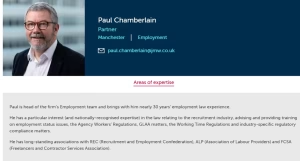
Paul Chamberlain is a Partner and Head of the Employment Team at JMW Solicitors in Manchester. He has nearly three decades of employment law experience.
His practice is particularly recognised for advice involving recruitment businesses, employment status, agency workers and employment regulations. He also handles broader employment disputes and has experience representing individuals in workplace disagreements.
| Details | Information |
| Law Firm | JMW Solicitors LLP |
| Position | Partner And Head Of Employment |
| Location | Manchester |
| Experience | Nearly 30 Years In Employment Law |
| Specialisations | Employment Disputes, Recruitment Law, Agency Workers And Employment Status |
| Consultation Fees | Confirm Directly With The Firm |
| Official Website | JMW Solicitors |
Why Choose Paul Chamberlain?
Paul’s specialist knowledge of recruitment and employment relationships can be valuable in disputes involving unusual contractual arrangements, employment status or complex workplace obligations.
He combines employment-law advice with experience in negotiation and practical dispute resolution.
Who Is He Best Suited For?
He may be especially relevant to recruitment businesses, senior professionals and individuals with complex employment status or contractual disputes.
Prospective employee claimants should confirm whether he can accept their particular matter.
Contact: Visit Paul Chamberlain’s Official Profile
9. Anita Rai – JMW Solicitors

Anita Rai is a Partner and Head of the London Employment Team at JMW Solicitors. She joined the firm in 2019 and advises businesses, founders, senior executives and professionals on employment matters.
Her practice includes discrimination, whistleblowing, employment contracts, workplace investigations, executive exits and sensitive employment disputes.
| Details | Information |
| Law Firm | JMW Solicitors LLP |
| Position | Partner And Head Of London Employment |
| Location | London |
| Experience | Joined JMW In 2019 |
| Specialisations | Executive Disputes, Discrimination, Whistleblowing And Employment Negotiations |
| Consultation Fees | Confirm Directly With The Firm |
| Official Website | JMW Solicitors |
Why Choose Anita Rai?
Anita has experience representing senior executives in disputes involving workplace treatment, discrimination and whistleblowing. She also advises organisations on contentious employment matters.
Her understanding of both employee and employer perspectives is particularly relevant when negotiating sensitive employment exits and resolving complex disagreements.
Who Is She Best Suited For?
She may be suitable for senior executives, founders and professionals involved in high-value employment disputes or negotiations requiring careful consideration of contractual and reputational issues.
Contact: Visit Anita Rai’s Official Profile
10. Peter De Maria – Doyle Clayton

Peter De Maria is Senior Partner and Head of the City Office at Doyle Clayton. He has more than 25 years of experience advising on employment and partnership law.
His clients include senior executives, partners, regulated professionals and businesses dealing with complex employment issues. His expertise covers restrictive covenants, contentious departures, whistleblowing, discrimination and high-value litigation.
| Details | Information |
| Law Firm | Doyle Clayton |
| Position | Senior Partner And Head Of City Office |
| Location | London |
| Experience | More Than 25 Years |
| Specialisations | Executive Employment Disputes, Restrictive Covenants, Whistleblowing And Litigation |
| Consultation Fees | Confirm Directly With The Firm |
| Official Website | Doyle Clayton |
Why Choose Peter De Maria?
Peter’s practice focuses on complex employment and partnership disputes involving senior professionals.
He is experienced in handling sensitive departures, restrictive covenants and legal disagreements with significant financial consequences.
His work also includes disputes involving contractual remuneration, which may be relevant where unpaid employment bonuses or other agreed payments form part of a wider contractual disagreement.
Who Is He Best Suited For?
He may be particularly appropriate for executives, financial services professionals, partners and senior employees facing complicated or high-value employment disputes.
Contact: Visit Peter De Maria’s Official Profile
How Can A Solicitor Help With A Constructive Dismissal Claim?
A constructive dismissal solicitor can assist at several stages of an employment dispute, from identifying a potential contractual breach to preparing a legal claim.
Their role is not limited to representing employees at tribunals. In many situations, receiving legal advice before resignation may help employees understand their position or explore an alternative resolution.
The main services include:
- Assessing Your Employment Contract And Eligibility: Reviewing contractual terms, employment history and employer conduct to determine whether a legally arguable claim exists.
- Gathering Evidence Of Employer Misconduct: Examining relevant emails, pay records, grievance correspondence, contracts and witness evidence.
- Advising On Grievances And Resignation: Explaining whether formal complaints, further communication or resignation may affect the employee’s legal position.
- Negotiating Settlement Agreements: Discussing possible financial compensation, notice payments, references and agreed departure terms.
- Handling Acas Early Conciliation: Representing or advising the employee during attempts to resolve the dispute before tribunal proceedings.
- Preparing Employment Tribunal Claims: Assisting with claim forms, witness statements, disclosure requirements and hearing preparation.
- Calculating Potential Compensation: Assessing lost earnings, benefits, pension losses and other recoverable financial losses.
Compensation for constructive unfair dismissal can include a basic award and a compensatory award, subject to the relevant legal rules.
The amount depends on individual circumstances, including financial losses and efforts to find alternative employment.
From 1 January 2027, the existing statutory cap on compensatory awards for ordinary unfair dismissal will be removed in Great Britain.
This does not mean every successful claimant will receive unlimited compensation. Awards will still be assessed according to applicable legal principles and proven losses.
Employees considering a claim should also understand the importance of timing. For most claims arising on or after 1 October 2026, the tribunal deadline is six months minus one day.
Earlier cases may follow different deadlines, and notifying Acas for early conciliation affects the calculation.
A formal workplace grievance does not itself stop the tribunal clock. Employees should therefore seek advice about both the internal dispute and the legal deadline.
How To Choose The Right Constructive Dismissal Solicitor?
Choosing an employment solicitor involves more than looking at their professional title or the size of their law firm.
Constructive dismissal claims can be difficult to establish, so it is important to find someone who understands the legal requirements and has relevant experience with similar disputes.
Consider the following factors before appointing a solicitor:
- Check Employment Law Experience: Look for solicitors who regularly handle unfair dismissal, contractual disputes and employment tribunal matters.
- Compare Solicitor Fees And Funding Options: Ask about hourly rates, fixed-fee assessments, funding arrangements and likely total costs.
- Review Client Feedback And Professional Credentials: Read independent client reviews and confirm the solicitor’s professional status through the Solicitors Regulation Authority.
- Ask About Constructive Dismissal Case Experience: Establish whether the solicitor has dealt with similar factual circumstances and whether they regularly represent employees.
- Confirm Availability And Tribunal Representation: Check whether the solicitor can accept your case within the applicable deadline and whether they will personally handle tribunal work.
It is also useful to ask how the solicitor assesses the strengths and weaknesses of a case.
An experienced professional should explain the legal risks, potential costs and alternatives rather than guarantee compensation or a successful tribunal outcome.
Employees should prepare their employment contract, relevant correspondence, a chronology of incidents and any existing grievance documentation before their initial consultation.
A clear explanation of the events leading to the potential resignation will help the solicitor assess whether the employer’s conduct could amount to a fundamental contractual breach.
Conclusion
Constructive dismissal claims can arise when an employer’s serious conduct or contractual breach leaves an employee feeling unable to continue working.
However, successfully proving constructive dismissal requires more than demonstrating unfair or unpleasant treatment.
The right solicitor can assess the employment relationship, identify relevant evidence, explain legal deadlines and advise on the potential consequences of resignation.
The ten solicitors featured in this article work across different areas of employment law.
Some focus heavily on senior executives or employer-side disputes, while others have published experience advising individual employees on unfair dismissal and related claims.
Before choosing legal representation, compare expertise, professional credentials, fee arrangements and suitability for your circumstances.
Most importantly, seek legal advice before resigning wherever possible, as resignation timing and the reasons given for leaving can significantly affect a potential constructive dismissal claim.
Frequently Asked Questions
1. Can I Claim Constructive Dismissal With Less Than Two Years Of Service?
Sometimes. Certain automatically unfair dismissal claims do not require two years’ service, and the qualifying period for ordinary unfair dismissal in Great Britain will reduce to six months from 1 January 2027.
2. How Much Does A Constructive Dismissal Solicitor Cost?
Costs depend on the solicitor’s hourly rate, the complexity of your claim and the services required. Some firms offer fixed-fee consultations, while others charge according to the time spent on your case.
3. Can I Find A No Win No Fee Constructive Dismissal Solicitor?
Some employment solicitors offer conditional fee arrangements, but availability depends on the strength and circumstances of the claim. Always check potential deductions, additional charges and liability for other costs.
4. What Evidence Do I Need To Prove Constructive Dismissal?
Useful evidence can include employment contracts, emails, wage records, grievance correspondence and witness statements. You must also show that a serious contractual breach caused your resignation.
5. Should I Resign Before Contacting A Constructive Dismissal Solicitor?
Generally, obtaining legal advice before resigning is advisable. A solicitor can assess the employer’s conduct and explain how resignation timing, notice and the reasons stated could affect your claim.
6. How Long Do I Have To Make A Constructive Dismissal Claim?
For most relevant disputes arising on or after 1 October 2026, the deadline is six months minus one day. Earlier claims may have a shorter deadline, and Acas early conciliation affects the calculation.
7. How Much Compensation Can I Receive For Constructive Dismissal?
Compensation depends on factors including lost earnings, benefits, length of service and the applicable legal rules. There is no guaranteed standard payout, and successful claims are assessed individually.
What is your reaction?