
Top 10 Discrimination Solicitors in the UK – Compare Lawyers and Legal Services

Last Updated: 12 November 2026
Discrimination solicitors in the UK provide legal advice and representation to people experiencing unlawful discrimination at work, in education, housing, public services and other areas.
They help clients understand their rights, gather evidence, negotiate settlements and pursue legal claims where appropriate.
The Equality Act 2010 provides the main framework for discrimination protection in England, Scotland and Wales.
Northern Ireland has separate equality legislation. The appropriate solicitor depends on the nature of the dispute, the location of the claim and the legal remedy being sought.
Choosing an experienced discrimination solicitor can make a substantial difference when dealing with complicated allegations or strict legal deadlines.
This article examines ten established lawyers working in discrimination-related and human rights practices, alongside practical guidance on legal costs, funding and making a claim.
What Do Discrimination Solicitors Do in the UK?
Discrimination solicitors specialise in legal disputes involving unfair treatment connected with characteristics protected by law.
They advise individuals, employees and organisations about their rights and responsibilities, including situations involving harassment, victimisation or policies that disproportionately disadvantage certain groups.
Their work can include reviewing employment records, preparing complaints, evaluating evidence, contacting the organisation responsible and providing representation in formal proceedings.
Depending on the circumstances, discrimination solicitors may assist with:
- Legal Advice: Explaining Rights, Responsibilities And Possible Claims
- Workplace Disputes: Addressing Discrimination, Harassment And Victimisation
- Evidence Preparation: Reviewing Documents, Communications And Witness Statements
- Settlement Negotiations: Seeking An Agreement Without A Full Hearing
- Tribunal Representation: Preparing And Presenting Employment Tribunal Claims
- Civil Court Proceedings: Pursuing Relevant Housing, Services Or Public Authority Claims
Not every form of unfair treatment is automatically unlawful discrimination. A solicitor will assess whether the conduct falls within the relevant legislation and whether sufficient evidence exists to support a claim.
When Should You Contact a Discrimination Solicitor?
Individuals should consider contacting a discrimination solicitor as soon as they believe they have experienced unlawful discrimination, particularly if the situation affects their employment, financial security, accommodation or access to services.
Early legal advice can help preserve evidence, clarify available remedies and prevent important deadlines from being overlooked.
Common situations that may justify seeking specialist advice include being refused a promotion because of a protected characteristic, experiencing repeated discriminatory harassment, being denied reasonable disability adjustments or facing unfavourable treatment after raising an equality complaint.
Employees who have experienced repeated problems may initially use their employer’s internal complaints procedure. Specialist grievance solicitors can help assess the circumstances and explain the available options.
However, an internal complaint does not automatically extend the deadline for an employment tribunal claim. Legal advice should therefore be sought promptly where formal proceedings are being considered.
How to Choose the Best Discrimination Solicitor for Your Case?
Selecting the right discrimination solicitor requires more than checking general experience or a firm’s reputation.
Different legal professionals concentrate on employment disputes, disability rights, public authority challenges or complex human rights litigation.
The most suitable solicitor should have experience dealing with the particular kind of discrimination involved.
Important Factors to Consider Include:
- Relevant Specialisation: Look For Experience With Similar Discrimination Claims
- Professional Regulation: Check The Solicitor And Firm’s Regulatory Status
- Case Experience: Review Relevant Published Cases And Areas Of Practice
- Client Reviews: Consider Independent Feedback Without Relying On Ratings Alone
- Legal Costs: Request Clear Information About Fees And Funding Arrangements
- Communication: Understand Who Will Handle The Case And Provide Updates
- Location And Accessibility: Check Whether Remote Consultations Are Available
A solicitor experienced in employment tribunal discrimination claims may be more appropriate for workplace disputes than a lawyer whose practice mainly involves international human rights litigation.
For employment-related cases, comparing the experience of employment lawyers in London can also help identify the type of expertise required.
Clients should confirm whether a solicitor accepts individual claims, provides an initial consultation and offers representation under an appropriate funding arrangement before formally instructing the firm.
Top 10 Best Discrimination Solicitors in the UK
The following ten legal professionals have established practices involving discrimination-related matters, civil liberties or human rights.
Their specialisms differ, and some focus primarily on public law rather than routine workplace discrimination claims.
The list is an editorial selection, not a verified ranking of case success rates or client satisfaction. No-win-no-fee availability should be confirmed directly with the relevant firm.
1. Mark Stephens CBE – Howard Kennedy LLP

Mark Stephens CBE is a consultant solicitor at Howard Kennedy LLP, a London-based law firm.
He has extensive experience in human rights, civil liberties and complex litigation, including legal matters involving freedom of expression, privacy and constitutional rights.
His professional background includes advising individuals, organisations and international clients on sensitive legal disputes.
His published experience also includes advice connected with workplace sexual harassment and the relationship between business practices and human rights obligations.
- Law Firm: Howard Kennedy LLP
- Location: London, United Kingdom
- Specialisation: Human Rights, Civil Liberties, Complex Litigation And Media Law
- Experience: International Litigation, Constitutional Rights And Regulatory Matters
- Funding Options: No Win No Fee Availability Not Publicly Confirmed
- Professional Recognition: Chambers UK 2026 Band 1 Ranking In International Human Rights Law
- Official Website: View Mark Stephens’ Profile
Why Consider This Solicitor?
Mark Stephens may be suitable for clients facing complex disputes involving civil liberties, human rights and related legal issues.
Individuals seeking conventional employment tribunal representation should first confirm whether their particular discrimination claim falls within his current practice.
2. Jamie Beagent – Leigh Day

Jamie Beagent is a partner and joint head of the human rights department at Leigh Day.
He specialises in public law and judicial review, particularly challenges involving decisions or actions taken by government departments and other public authorities.
His work also includes advising on litigation strategy, legal funding and the wider implications of public authority decisions.
His experience is relevant to cases where alleged discrimination is connected with government policy or the exercise of public powers.
- Law Firm: Leigh Day
- Location: London, United Kingdom
- Specialisation: Human Rights, Public Law And Judicial Review
- Experience: Challenges Against Government Departments And Public Authorities
- Funding Options: Legal Funding Arrangements Subject To Case Assessment
- Professional Focus: Public Interest Litigation And Strategic Legal Challenges
- Official Website: View Jamie Beagent’s Profile
Why Consider This Solicitor?
Jamie Beagent may be appropriate for individuals or organisations challenging public authority decisions, particularly where equality concerns form part of a broader public law dispute.
His published expertise is not primarily centred on ordinary employment discrimination cases.
3. Andre Clovis – Twelve Tabulae
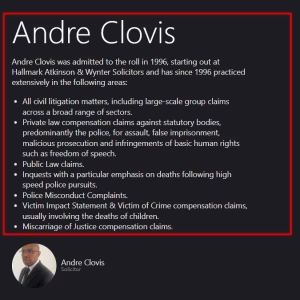
Andre Clovis is a solicitor at Twelve Tabulae with extensive experience in civil litigation, police misconduct complaints and human rights-related claims.
He was admitted as a solicitor in 1996 and has worked on legal disputes involving public authorities and allegations of unlawful conduct.
He previously worked as a consultant solicitor at Tuckers Solicitors before moving to Twelve Tabulae in December 2025.
His practice includes compensation claims involving false imprisonment, assault, malicious prosecution and alleged infringements of fundamental rights.
- Law Firm: Twelve Tabulae
- Location: United Kingdom
- Specialisation: Civil Liberties, Police Misconduct And Human Rights Claims
- Experience: Civil Litigation And Public Authority Disputes Since 1996
- Funding Options: Current Funding Arrangements Require Confirmation
- Relevant Casework: Civil Claims Against Police And Other Statutory Bodies
- Official Website: View Andre Clovis’ Profile
Why Consider This Solicitor?
Andre Clovis may be suitable for individuals seeking representation in civil claims involving police misconduct or alleged violations of human rights.
His experience is particularly relevant where discrimination concerns arise alongside unlawful detention or other public authority actions.
4. Carolynn Gallwey – Bhatt Murphy
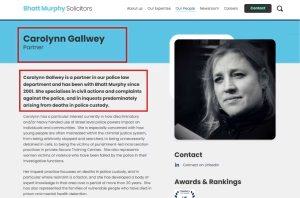
Carolynn Gallwey is a partner in the police law department at Bhatt Murphy.
She has worked with the firm since 2001 and specialises in civil actions against police forces, complaints concerning official misconduct and inquests involving deaths in detention.
Her work includes challenging discriminatory policing practices and the inappropriate use of police powers.
She has particular experience dealing with cases involving stop and search, detention and the treatment of vulnerable individuals by public authorities.
- Law Firm: Bhatt Murphy
- Location: London, United Kingdom
- Specialisation: Police Law, Civil Liberties, Discrimination And Inquests
- Experience: Police Misconduct Claims And Human Rights Litigation
- Funding Options: Subject To Individual Case Assessment
- Professional Recognition: Chambers UK 2026 Band 1 Ranking In Claimant Police Law
- Official Website: View Carolynn Gallwey’s Profile
Why Consider This Solicitor?
Carolynn Gallwey may be particularly suitable for people who believe they have experienced discriminatory treatment by police officers or other criminal justice authorities.
Her specialist experience also covers claims connected with detention and alleged breaches of human rights.
5. Ingrid Gubbay – Hausfeld & Co LLP

Ingrid Gubbay is Of Counsel at Hausfeld and has extensive experience in human rights, environmental litigation and public interest legal challenges.
Her work involves representing individuals and communities affected by alleged corporate misconduct and violations of fundamental rights.
Her professional experience includes strategic litigation, judicial review and disability-related discrimination matters. She has also worked on public interest campaigns involving equality and access to essential services.
- Law Firm: Hausfeld & Co LLP
- Location: London, United Kingdom
- Specialisation: Human Rights, Environmental Litigation And Public Interest Claims
- Experience: Strategic Litigation And Claims Involving Corporate Conduct
- Funding Options: Available Arrangements Depend On The Proposed Claim
- Professional Recognition: Recognised In The Legal 500 UK 2026 For Human Rights And Environmental Work
- Official Website: View Ingrid Gubbay’s Profile
Why Consider This Solicitor?
Ingrid Gubbay may be appropriate for clients dealing with complex human rights matters, particularly disputes involving businesses, disability rights or significant public interest questions.
Her practice is broader than conventional workplace discrimination representation.
6. Toufique Hossain – Duncan Lewis Solicitors

Toufique Hossain is a director and solicitor in the public law practice at Duncan Lewis Solicitors.
He has more than two decades of legal experience and specialises in strategic litigation involving immigration, government decisions and human rights protections.
His work includes representing individuals and organisations challenging allegedly unlawful policies or actions by public authorities.
He has participated in significant judicial review proceedings and cases involving immigration detention, asylum and fundamental rights.
- Law Firm: Duncan Lewis Solicitors
- Location: City Of London, United Kingdom
- Specialisation: Public Law, Immigration And Human Rights Litigation
- Experience: High-Profile Judicial Reviews And Strategic Legal Challenges
- Funding Options: Experience With Legal Aid And Other Case-Specific Funding Arrangements
- Professional Recognition: Recognised By Chambers UK And Legal 500 In 2026
- Official Website: View Toufique Hossain’s Profile
Why Consider This Solicitor?
Toufique Hossain may be suitable for people challenging government policies, immigration decisions or other public authority actions involving human rights concerns.
Clients should check whether their discrimination matter falls within his public law practice.
7. Neil Hudgell – Hudgell Solicitors

Neil Hudgell established Hudgell Solicitors in 1997 and is the firm’s executive chairman.
He is particularly associated with civil liberties, public inquiries, inquests and significant compensation claims involving institutional failings.
The firm represents individuals and families in complex legal disputes, including cases involving allegations of misconduct and failures by public bodies.
Its work has included nationally significant inquiries and group actions.
- Law Firm: Hudgell Solicitors
- Location: Hull, With Offices Including London, Manchester And Newcastle
- Specialisation: Civil Liberties, Public Inquiries And Inquests
- Experience: High-Profile Claims Involving Public Bodies And Institutions
- Funding Options: Funding Depends On The Case And Relevant Legal Team
- Professional Recognition: Chambers UK 2026 Band 2 Ranking In Inquests
- Official Website: Visit Hudgell Solicitors
Why Consider This Solicitor?
Neil Hudgell’s experience may be relevant to serious disputes involving institutional conduct, public inquiries or civil liberties. Individuals seeking representation for routine workplace discrimination should verify that the firm’s relevant department accepts such claims.
8. Sean Humber – Leigh Day

Sean Humber is a partner in the human rights department at Leigh Day. His practice covers discrimination, privacy, data protection, prisoner rights and public law matters.
He has experience representing individuals whose legal rights have allegedly been infringed by public authorities or other organisations.
His published work includes disability discrimination issues affecting prisoners and legal challenges concerning healthcare and the treatment of vulnerable individuals.
- Law Firm: Leigh Day
- Location: London, United Kingdom
- Specialisation: Discrimination, Human Rights, Privacy And Prison Law
- Experience: Disability Discrimination And Public Authority Claims
- Funding Options: Funding Arrangements Subject To Eligibility And Case Assessment
- Professional Focus: Human Rights Litigation And Claims Involving Vulnerable Individuals
- Official Website: View Sean Humber’s Profile
Why Consider This Solicitor?
Sean Humber may be suitable for individuals facing discrimination in institutional settings, particularly where disability rights or public authority responsibilities are involved.
His experience also extends to claims concerning privacy and the protection of personal information.
9. Matthew Jury – McCue Jury & Partners

Matthew Jury is the managing partner of McCue Jury & Partners and is qualified to practise as a solicitor in England and Wales and as an attorney in New York.
His legal practice includes domestic and international human rights law, public international law and complex litigation.
He also has experience in evidence gathering, legal investigations and matters involving significant public interest considerations.
- Law Firm: McCue Jury & Partners
- Location: United Kingdom
- Specialisation: International Human Rights, Public International Law And Complex Litigation
- Experience: Multi-Jurisdictional Litigation And Strategic Legal Campaigns
- Funding Options: Current Funding Arrangements Require Direct Confirmation
- Professional Recognition: Shortlisted For Law Society Solicitor And Human Rights Awards In 2021
- Official Website: View Matthew Jury’s Profile
Why Consider This Solicitor?
Matthew Jury may be appropriate for clients involved in complex human rights disputes or international legal challenges.
His published specialisms are distinct from routine employment tribunal discrimination work, so prospective clients should confirm that their claim is within the firm’s scope.
10. Susie Labinjoh – Hodge Jones & Allen

Susie Labinjoh is a partner and head of the Civil Liberties and Human Rights Team at Hodge Jones & Allen.
She qualified as a solicitor in 1999 and has substantial experience representing clients in civil claims against the police and prison services.
Her practice includes human rights claims, public law challenges and compensation matters involving alleged misconduct by state authorities.
She also has experience representing individuals affected by miscarriages of justice and disputes involving the exercise of public powers.
- Law Firm: Hodge Jones & Allen
- Location: London, United Kingdom
- Specialisation: Civil Liberties, Human Rights And Police Actions
- Experience: Claims Against Police Forces And Prison Authorities
- Funding Options: Subject To Case Eligibility And Firm Assessment
- Professional Background: Qualified As A Solicitor In 1999
- Official Website: View Susie Labinjoh’s Profile
Why Consider This Solicitor?
Susie Labinjoh may be suitable for individuals whose discrimination concerns involve police conduct, detention or alleged human rights violations by public authorities.
Her experience is especially relevant to civil liberties disputes rather than standard employment discrimination claims.
What Types of Discrimination Cases Do Solicitors Handle?
Discrimination solicitors deal with different types of unlawful treatment depending on the circumstances and the legislation involved.
The Equality Act 2010 protects nine characteristics in England, Scotland and Wales.
These are age, disability, gender reassignment, marriage and civil partnership, pregnancy and maternity, race, religion or belief, sex and sexual orientation.
The legal protections are not identical in every setting or for every characteristic.
Understanding the nine protected characteristics can help individuals recognise situations where specialist advice may be appropriate.
Discrimination cases commonly involve the following areas.
- Workplace Discrimination: Unlawful Treatment During Recruitment, Promotion, Employment Or Dismissal
- Race And Religious Discrimination: Unfavourable Treatment Connected With Race, Nationality, Religion Or Belief
- Disability And Mental Health Discrimination: Unlawful Disability-Related Treatment Or Failure To Make Reasonable Adjustments
- Pregnancy And Maternity Discrimination: Unlawful Treatment Connected With Pregnancy Or Maternity Leave
- Sex And Age Discrimination: Unlawful Treatment Related To Sex Or Age
- Housing And Service Discrimination: Unlawful Treatment When Renting Property Or Accessing Goods And Services
Discrimination can also involve harassment, victimisation or indirect discrimination.
Direct discrimination generally involves treating someone less favourably because of a protected characteristic.
Indirect discrimination can arise where a policy applied to everyone places people sharing a protected characteristic at a particular disadvantage and cannot be legally justified.
Disability discrimination may also involve failing to make reasonable adjustments or treating someone unfavourably because of something arising from their disability, subject to the relevant legal tests.
The circumstances determine whether a discrimination solicitor should pursue an employment tribunal claim, civil court proceedings or another legal route.
How Much Do Discrimination Solicitors Charge in the UK?
The cost of hiring a discrimination solicitor depends on the complexity of the claim, the amount of legal work involved, the experience of the legal professional and the funding arrangement agreed with the client.
Some solicitors charge hourly rates, while others offer fixed fees for particular services such as an initial assessment, document review or settlement agreement advice.
For more complicated discrimination claims, clients may need representation over several months or longer.
The final cost can therefore be influenced by the amount of evidence, the number of witnesses, the need for expert reports and whether the dispute proceeds to a hearing.
Clients should request written information about fees, VAT, barristers’ charges, expert costs and potential liabilities before instructing a solicitor.
Can You Get a No Win No Fee Discrimination Solicitor?
Some discrimination solicitors accept suitable cases under no-win-no-fee arrangements.
These may include conditional fee agreements or other funding models where some or all legal fees depend on the outcome.
However, no win no fee does not necessarily mean there are no financial risks. Depending on the agreement, a client may still face certain expenses, additional charges or liabilities.
Employees considering this funding option can compare how no-win, no-fee employment solicitors structure their services and assess the types of claims they may accept.
Before signing an agreement, clients should establish what happens if the claim succeeds, settles early or is unsuccessful.
They should also confirm whether a success fee applies and how any compensation would be affected.
Is Legal Aid Available for Discrimination Cases?
Legal aid may be available for eligible discrimination matters in England and Wales, subject to financial and legal eligibility requirements.
The availability of funding depends on the nature of the dispute, the applicant’s circumstances and the legal assistance required.
Legal aid is not automatically available for every employment disagreement.
Scotland and Northern Ireland operate separate legal aid systems with different eligibility arrangements.
Individuals can check their eligibility through GOV.UK’s legal aid guidance or contact an authorised legal aid provider.
How Can a Discrimination Solicitor Help You Make a Claim?
A discrimination solicitor can assess whether a claim has a reasonable legal basis, identify the correct procedure and advise on the evidence required.
The process usually begins with examining the circumstances, determining which legal protections may apply and establishing the relevant time limit.
What Evidence Do You Need for a Discrimination Claim?
A solicitor may request documents showing what happened, when the alleged conduct occurred and how the individual was affected.
Useful Evidence May Include:
- Emails And Messages: Communications Relevant To The Alleged Discrimination
- Employment Records: Contracts, Appraisals, Disciplinary Letters And Pay Information
- Witness Statements: Accounts From People Who Observed Relevant Events
- Complaint Records: Grievances, Responses And Investigation Outcomes
- Medical Evidence: Records Relevant To Disability Or Health-Related Consequences
- Financial Documents: Evidence Of Lost Earnings Or Other Financial Losses
A clear chronology can help the solicitor identify relevant incidents and distinguish between potential legal claims.
Evidence should be collected and preserved lawfully. Clients should avoid accessing confidential information without permission and should seek advice about which documents can properly be used.
How Long Do You Have to Make a Discrimination Claim?
Time limits are particularly important in discrimination cases because missing the deadline can prevent a claim from proceeding.
Under the employment tribunal rules applying in Great Britain from 1 October 2026, most claims concerning incidents occurring on or after that date have a time limit of six months minus one day.
For most workplace discrimination incidents occurring before 1 October 2026, the previous limit of three months minus one day generally applies.
The correct deadline can depend on the date of the incident, whether there was a continuing course of discrimination and other relevant circumstances.
Before bringing most employment tribunal claims, individuals must notify ACAS.
Early Conciliation provides an opportunity to resolve the dispute without formal tribunal proceedings and can pause the limitation clock when notification is made within the applicable time limit.
Time limits for discrimination claims involving housing, services or other civil matters can differ from employment tribunal rules.
A discrimination solicitor can identify the correct court or tribunal, calculate the relevant deadline and advise whether the available evidence supports legal action.
Depending on the circumstances, a successful discrimination claim may result in compensation for financial loss, injury to feelings or other remedies available under the applicable law.
Conclusion
Choosing the right discrimination solicitor in the UK depends on the type of unlawful treatment involved, the experience of the legal professional and the funding arrangements available.
The ten solicitors discussed have established experience in areas connected with discrimination, civil liberties or human rights, although their individual specialisms vary considerably.
Some focus on public authority claims and complex litigation rather than ordinary employment tribunal disputes.
Individuals considering legal action should compare solicitors carefully, check their professional credentials and obtain clear advice about costs and deadlines.
Seeking appropriate legal advice early can help protect important rights, preserve evidence and identify the most suitable route for resolving a discrimination dispute.
Frequently Asked Questions About Discrimination Solicitors
How Much Does a Discrimination Solicitor Cost in the UK?
Costs vary according to the solicitor’s experience, case complexity and funding arrangement. Some firms provide fixed-fee services, while others charge hourly rates or offer conditional fee agreements.
Can I Get a Free Consultation With a Discrimination Solicitor?
Some discrimination solicitors offer free initial consultations or preliminary assessments. Availability varies between firms, so prospective clients should check before booking an appointment.
Are No Win No Fee Discrimination Solicitors Available in the UK?
Yes, some firms offer no-win-no-fee arrangements for eligible discrimination claims. Acceptance depends on the circumstances, and clients should check all possible fees and expenses before signing an agreement.
How Do I Find the Best Discrimination Solicitor Near Me?
Search for solicitors specialising in the relevant type of discrimination, verify their regulatory status and compare their experience, fees and client reviews. Some firms also offer remote consultations.
Can I Make a Discrimination Claim Without a Solicitor?
Yes, individuals can represent themselves in employment tribunal proceedings.
However, specialist legal advice may be valuable where evidence is complicated, deadlines are uncertain or substantial compensation is involved.
How Long Does a Discrimination Case Take in the UK?
The duration depends on the complexity of the dispute, settlement negotiations and tribunal or court availability. Some claims settle relatively quickly, while others can take many months or longer.
Can I Claim Discrimination After Leaving My Job?
Yes, former employees may bring discrimination claims where the legal requirements are satisfied.
They must still follow the relevant time limits, which are usually calculated by reference to the alleged discriminatory conduct rather than simply the date they left employment.
What is your reaction?