
Best Flexible Working Solicitors in the UK: Top 10 Lawyers, Legal Rights and Costs

Last Updated: 11 November 2026
Finding the best flexible working solicitors in the UK can help employees protect their workplace rights and employers manage requests for changes to working hours, locations and schedules.
Employment law solicitors provide advice on flexible working applications, rejected requests, discrimination, contractual changes and workplace disputes.
Under current UK employment law, eligible employees in Great Britain can request flexible working from their first day of employment.
However, employers can refuse requests for certain business reasons, making specialist legal advice valuable when disagreements arise.
The ten legal professionals below have appeared in an existing flexible-working solicitor shortlist.
Their current practice areas have been reviewed to distinguish employment-law specialists from lawyers working primarily in other fields. The numbering is for reference and does not represent a verified national ranking.
Employees looking for additional legal representation can also compare employment lawyers in London according to their workplace disputes, professional experience and legal requirements.
What Do Flexible Working Solicitors Do?
Flexible working solicitors are employment law professionals who advise employees and employers about changing working hours, workplace locations and contractual arrangements.
They can help with requests for home working, hybrid schedules, compressed hours, part-time employment and job-sharing arrangements.
Their services may include reviewing employment contracts, preparing statutory flexible working applications, negotiating alternatives with employers and assessing whether a refusal complies with employment law.
When disagreements involve disability, caring responsibilities or potential discrimination, solicitors can also assess whether additional protections apply under the Equality Act 2010.
Legal assistance becomes particularly important when an employer rejects a request without following the correct procedure or when an employee experiences unfair treatment after asking for flexibility.
How to Choose the Best Flexible Working Solicitor in the UK?
The right solicitor depends on the circumstances of the request and whether legal advice is needed by an employee or an employer.
Someone challenging a rejected application may require a solicitor experienced in employee rights and employment tribunal claims.
Businesses introducing hybrid working policies may benefit from employer-side employment law specialists.
Before choosing a solicitor, consider the following:
- Employment Law Experience: Look for verified experience handling employment rights, contractual changes and workplace disputes.
- Relevant Case Expertise: Ask whether the solicitor has advised on flexible working refusals, discrimination or reasonable adjustments.
- Professional Regulation: Check the solicitor’s status through the Solicitors Regulation Authority or another relevant UK professional regulator.
- Consultation Availability: Confirm whether advice is available online, by telephone or through an office appointment.
- Transparent Legal Fees: Request written information about consultation charges, hourly rates and possible additional costs.
- Client Reviews: Examine independent reviews alongside the solicitor’s experience with comparable cases.
It is also important to understand how employment contract lawyers approach contractual changes when flexible working arrangements become permanent.
How Much Do Flexible Working Solicitors Charge in the UK?
The cost of hiring a flexible working solicitor depends on the complexity of the problem, the solicitor’s experience and the type of legal assistance required.
Some firms offer an initial assessment without charge, while others charge for their first consultation.
A straightforward review of a flexible working application may cost less than negotiating a disputed contract or representing an employee at an employment tribunal.
Common payment arrangements include:
- Fixed-Fee Consultations: An agreed charge for reviewing a specific workplace problem or document.
- Hourly Legal Fees: Charges based on the solicitor’s time and the complexity of the matter.
- Employment Contract Reviews: A fixed or hourly fee for examining proposed working arrangements.
- Workplace Dispute Representation: Additional fees for correspondence, negotiations and tribunal preparation.
- Conditional Fee Arrangements: Potential funding for suitable employment claims, depending on the firm’s assessment.
Not every firm offers conditional-fee arrangements, and such funding is not automatically available for flexible working disputes.
Employees considering this option can examine the circumstances in which no win no fee employment solicitors may accept a case.
Before proceeding, request a written estimate explaining the legal work included, applicable VAT, potential expenses and circumstances in which additional charges might arise.
Top 10 Best Flexible Working Solicitors in the UK
The following profiles retain the original shortlist while reflecting publicly available professional information as of November 2026.
Not all ten individuals have a verified specialism in flexible working. Readers should compare the relevant employment-law experience before making an enquiry.
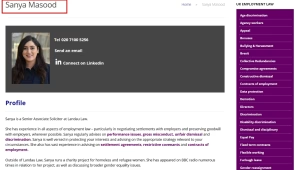
1. Sanya Masood – Landau Law Solicitors
- Law Firm: Landau Law Solicitors
- Location: London, UK
- Experience: Senior Associate Solicitor With Employment Law Experience
- Specialisation: Employment Law, Discrimination, Unfair Dismissal and Settlement Agreements
- Best Suited For: Employees and Senior Executives Facing Workplace Disputes
- Official Website: Sanya Masood – Landau Law Solicitors
Sanya Masood is a Senior Associate Solicitor at Landau Law, a London-based employment law practice representing employees and senior executives.
Her published professional profile describes experience in workplace disputes, discrimination, performance issues, unfair dismissal and employment settlement agreements.
Employees experiencing difficulties with flexible working arrangements may find her employment law background relevant, particularly where disagreements concern changes to contractual terms, discrimination or an employer’s handling of workplace concerns.
Her experience in negotiating settlements may also be useful when both parties want to resolve a dispute without lengthy proceedings.
Why Consider Sanya Masood?
- Employment Law Knowledge: Advises on employee rights, discrimination, dismissal and workplace disputes.
- Settlement Negotiation Experience: Helps clients negotiate settlements and resolve employment disagreements.
- Employee-Focused Practice: Works within a firm specialising in legal services for employees and senior executives.
- Strategic Legal Advice: Assesses workplace problems and advises clients on appropriate legal options.
Consultation Fees: Contact Landau Law to confirm initial consultation availability, applicable fees and the likely cost of further representation.
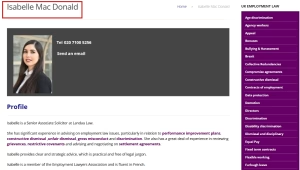
2. Isabelle Mac Donald – Landau Law Solicitors
- Law Firm: Landau Law Solicitors
- Location: London, UK
- Experience: Senior Associate Solicitor With Employment Law Experience
- Specialisation: Workplace Grievances, Discrimination, Constructive Dismissal and Settlement Agreements
- Best Suited For: Employees Challenging Workplace Decisions or Negotiating Employment Disputes
- Official Website: Isabelle Mac Donald – Landau Law Solicitors
Isabelle Mac Donald is a Senior Associate Solicitor at Landau Law who advises employees on a broad range of employment law matters.
Her professional background includes grievances, performance improvement plans, constructive dismissal, unfair dismissal, restrictive covenants and discrimination.
Her experience may be particularly relevant when flexible working disagreements develop into formal workplace grievances or concerns about unfair treatment.
Employees who believe their employer has failed to consider their circumstances properly may benefit from obtaining advice about their rights, evidence and possible next steps.
Why Consider Isabelle Mac Donald?
- Workplace Grievance Experience: Advises employees dealing with complaints and employment disagreements.
- Discrimination Knowledge: Handles legal issues involving potentially unlawful workplace treatment.
- Settlement Agreement Advice: Supports employees reviewing and negotiating employment settlements.
- Practical Communication: Her published profile emphasises clear, strategic advice that avoids unnecessary legal jargon.
Consultation Fees: Initial consultation arrangements and professional charges should be confirmed directly with Landau Law.
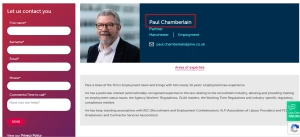
3. Paul Chamberlain – JMW Solicitors
- Law Firm: JMW Solicitors
- Location: Manchester, UK
- Experience: Nearly 30 Years of Employment Law Experience
- Specialisation: Employment Law, Recruitment Regulation, Working Time and Employment Status
- Best Suited For: Recruitment Businesses, Employers and Senior Executives
- Official Website: Paul Chamberlain – JMW Solicitors
Paul Chamberlain is a Partner and Head of Employment at JMW Solicitors in Manchester.
He has nearly three decades of employment law experience, with particular expertise in recruitment businesses, employment status, agency worker regulations and working time legislation.
His employment law background may be valuable to organisations reviewing working arrangements, workforce policies and contractual obligations.
Employers operating recruitment agencies or businesses with complicated staffing structures may particularly benefit from his experience with regulatory requirements and workforce management.
Why Consider Paul Chamberlain?
- Extensive Employment Law Experience: Has nearly 30 years of experience advising on employment-related legal matters.
- Recruitment Industry Expertise: Works with employment agencies, recruitment businesses and industry organisations.
- Working Time Knowledge: Advises on working time regulations and workforce compliance.
- Commercial Perspective: Helps organisations understand legal responsibilities alongside operational requirements.
Consultation Fees: JMW’s charges depend on the legal services required. Contact the employment team for consultation details and a written fee estimate.
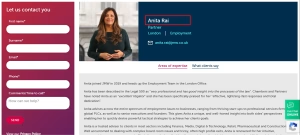
4. Anita Rai – JMW Solicitors
- Law Firm: JMW Solicitors
- Location: London, UK
- Experience: Partner and Head of the London Employment Team
- Specialisation: Employment Disputes, Discrimination, HR Advice and Executive Workplace Issues
- Best Suited For: Businesses, Senior Executives and Employees Facing Complex Employment Disputes
- Official Website: Anita Rai – JMW Solicitors
Anita Rai is a Partner at JMW Solicitors and leads its London employment team.
Her professional experience covers employment disputes, discrimination, workplace investigations, employee relations and complex employment issues affecting companies and senior executives.
She advises businesses ranging from start-ups to international organisations, alongside senior executives and founders.
Her experience with employee complaints, workplace policies and employment negotiations may be relevant when flexible working disagreements involve wider HR concerns or allegations of discriminatory treatment.
Why Consider Anita Rai?
- Employment Law Leadership: Heads JMW’s London employment team.
- Employer and Executive Representation: Advises businesses, senior executives and company founders.
- Discrimination and Workplace Disputes: Has experience handling allegations of workplace discrimination and other employment claims.
- Complex Negotiation Experience: Advises clients on sensitive workplace conflicts and negotiated resolutions.
Consultation Fees: Contact JMW Solicitors to discuss consultation availability, hourly charges and possible fixed-fee services.
5. Anthony Okumah – Duncan Lewis Solicitors

- Law Firm: Duncan Lewis Solicitors
- Location: City of London, UK
- Experience: Qualified as a Solicitor in 2005
- Specialisation: Civil Litigation, Commercial Disputes and Professional Negligence
- Best Suited For: Individuals and Businesses With Complex Civil or Commercial Disputes
- Official Website: Anthony Okumah – Duncan Lewis Solicitors
Anthony Okumah is a Director and Solicitor at Duncan Lewis, specialising primarily in civil litigation and dispute resolution.
His professional work includes commercial disputes, professional negligence, insolvency matters and complex litigation involving businesses and individuals.
Although his litigation experience is substantial, his published practice information does not establish flexible working or employment rights as a principal specialism.
Employees seeking advice specifically about rejected flexible working applications should confirm whether he handles such matters or request referral to Duncan Lewis’s employment law team.
Why Consider Anthony Okumah?
- Civil Litigation Experience: Advises clients on complex civil and commercial disputes.
- Dispute Resolution Knowledge: Has experience with negotiation, mediation and litigation.
- Business Dispute Expertise: Works on matters involving contractual and commercial disagreements.
- Established Legal Career: Has practised as a solicitor since 2005.
Consultation Fees: Request a fee estimate directly from Duncan Lewis and confirm whether your matter falls within his practice.
6. Tamana Aziz – Duncan Lewis Solicitors

- Law Firm: Duncan Lewis Solicitors
- Location: City of London, UK
- Experience: Providing Immigration Advice Since 2001
- Specialisation: Business Immigration, Sponsor Licence Compliance and Immigration Litigation
- Best Suited For: Employers and Employees With Immigration-Related Workplace Issues
- Official Website: Tamana Aziz – Duncan Lewis Solicitors
Tamana Aziz is a Director and Solicitor in the immigration practice at Duncan Lewis Solicitors.
Her experience includes business immigration, skilled worker visas, employer sponsorship obligations, immigration appeals and compliance with right-to-work requirements.
Her work may be relevant where workplace changes raise questions about sponsored employment, immigration permission or an employer’s sponsorship duties.
However, immigration advice and statutory flexible working representation are different legal services, and her professional biography does not identify flexible working disputes as a core specialism.
Why Consider Tamana Aziz?
- Business Immigration Expertise: Advises organisations on immigration-related employment obligations.
- Employer Compliance Knowledge: Has experience with sponsor licences and right-to-work requirements.
- Immigration Litigation Experience: Handles complex immigration applications, appeals and proceedings.
- Established Professional Recognition: Has received recognition in legal directories for immigration work.
Consultation Fees: Contact Duncan Lewis for current immigration consultation fees and confirm whether specialist employment advice is also required.
7. Ayushi Chadha – Anthony Gold Solicitors

- Law Firm: Anthony Gold Solicitors, Formerly IBB Law
- Location: London Bridge, London, UK
- Experience: Qualified as an English Solicitor in 2021
- Specialisation: Commercial Dispute Resolution, Contractual Disputes and Civil Litigation
- Best Suited For: Businesses and Individuals Facing Commercial or Contractual Disagreements
- Official Website: Ayushi Chadha – Anthony Gold Solicitors
Ayushi Chadha is an Associate Solicitor at Anthony Gold, working within its Commercial and Civil Dispute Resolution team.
Her experience includes contractual disputes, debt recovery, shareholder disagreements, professional negligence and other commercial litigation matters.
She previously worked at IBB Law, but her current professional profile identifies Anthony Gold as her firm.
Her expertise is primarily commercial rather than employment-related. Someone seeking legal assistance with statutory flexible working rights should therefore establish whether their problem requires an employment solicitor rather than a commercial disputes specialist.
Why Consider Ayushi Chadha?
- Commercial Dispute Experience: Advises on contractual and business-related disagreements.
- Litigation Knowledge: Handles commercial claims and alternative dispute resolution.
- Recognition for Legal Work: Has been recognised by The Legal 500 for commercial dispute resolution.
- Experience With Different Clients: Represents companies, smaller businesses and individuals.
Consultation Fees: Contact Anthony Gold to obtain current consultation charges and a fee estimate for the relevant type of dispute.
8. Letitia Ait-Tales – Formerly IBB Law

- Law Firm: Formerly IBB Law, Acquired by Knights
- Location: Historical Association With the Thames Valley
- Experience: Previously Identified as a Solicitor in Residential Development
- Specialisation: Residential Development and Property-Related Legal Work
- Best Suited For: Property-Related Matters Rather Than Verified Flexible Working Claims
- Official Website: Knights – IBB Law Acquisition Information
Letitia Ait-Tales was previously associated with IBB Law, where publicly available professional information identified her work in residential development.
IBB Law subsequently became part of Knights following an acquisition completed in April 2025.
Her current professional affiliation and any involvement in flexible working disputes have not been independently established from an up-to-date individual solicitor profile.
As residential development and employment law are different practice areas, readers should not assume that she currently provides flexible working advice.
Why Consider Letitia Ait-Tales?
- Residential Development Background: Historical professional information connects her with property development matters.
- Former IBB Law Association: Previously worked within an established Thames Valley law firm.
- Professional Background: Has previously been identified as a qualified solicitor in the firm’s residential development team.
- Current Status Requires Confirmation: Any enquiry should begin by verifying her current firm and available services.
Consultation Fees: Current charges and availability could not be verified. Confirm her professional status and relevant expertise before making an enquiry.
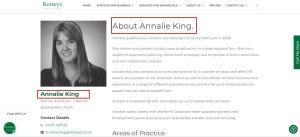
9. Annalie King – Kerseys Solicitors
- Law Firm: Kerseys Solicitors
- Location: Ipswich, Suffolk, UK
- Experience: Qualified as an Employment Law Solicitor in 2008
- Specialisation: Employment Law, HR Advisory Services and Workplace Disputes
- Best Suited For: Employees and Employers Requiring Employment Law or HR Support
- Official Website: Annalie King – Kerseys Solicitors
Annalie King is a Partner and Head of Employment at Kerseys Solicitors.
She qualified as a solicitor specialising in employment law in 2008 and has experience representing both employers and employees in contentious and non-contentious employment matters.
Her background includes employment law advice, HR support and workplace matters arising during business changes and restructurings.
This combination may be useful for organisations developing flexible working policies and employees who need professional guidance when workplace arrangements become disputed.
Why Consider Annalie King?
- Employment Law Specialisation: Has practised in employment law since qualifying in 2008.
- Employer and Employee Experience: Advises both sides of employment-related disagreements.
- HR Advisory Knowledge: Provides employers with advice on workplace policies and employment responsibilities.
- Employment Team Leadership: Heads the employment department at Kerseys Solicitors.
Consultation Fees: Kerseys offers different employment and HR service arrangements. Contact the firm for individual consultation fees or business support pricing.
10. Adrian Chaffey – Kerseys Solicitors

- Law Firm: Kerseys Solicitors
- Location: Ipswich, Suffolk, UK
- Experience: Over 20 Years of Corporate and Commercial Legal Experience
- Specialisation: Corporate Law, Business Transactions and Commercial Agreements
- Best Suited For: Business Owners Seeking Corporate or Commercial Legal Advice
- Official Website: Adrian Chaffey – Kerseys Solicitors
Adrian Chaffey is a Senior Solicitor at Kerseys whose primary practice involves corporate and commercial law.
His professional experience includes business acquisitions, commercial contracts, joint ventures, investments and complex commercial agreements.
While his work provides experience of business operations and contractual arrangements, his official profile does not establish a specific flexible working employment-law practice.
Businesses needing advice on staff working arrangements would generally be better served by confirming the availability of Kerseys’ employment team.
Why Consider Adrian Chaffey?
- Commercial Law Experience: Has more than 20 years of experience advising businesses.
- Contractual Expertise: Works on commercial agreements and business transactions.
- Business Advisory Background: Advises corporate clients on investments and structural matters.
- Access to Wider Firm Services: Works at a firm that also maintains a dedicated employment law department.
Consultation Fees: His official profile states that initial conversations about proposed commercial transactions are free. Confirm whether this applies to your circumstances and obtain a fee estimate for further work.
What Are Your Legal Rights to Flexible Working in the UK?
Employees in England, Scotland and Wales have the statutory right to request flexible working from their first day of employment.
The right includes requests to change working hours, the days worked or the place where work is performed.
It can include part-time hours, compressed working weeks, flexible start times and home working arrangements.
Under the rules applying in November 2026:
- Day-One Eligibility: Employees can make a statutory flexible working request from their first day of employment.
- Two Requests Per Year: Employees can make up to two statutory requests within any twelve-month period.
- Written Applications: Requests must include specified information about the proposed changes and previous applications.
- Decision Deadline: Employers must normally respond within two months unless a longer period is agreed.
- Consultation Before Refusal: Employers must consult employees before rejecting statutory applications.
- Written Contractual Changes: Approved arrangements must be reflected in the employee’s employment terms.
The statutory right does not mean every flexible working application must be accepted.
Employers can refuse requests for one or more of eight permitted business reasons, including additional costs, difficulty reorganising work, an inability to recruit staff, negative effects on performance or quality, reduced ability to meet customer demand, insufficient work during the proposed hours and planned structural changes.
However, employers must handle requests reasonably and must not unlawfully discriminate against employees.
The GOV.UK flexible working guidance explains the statutory application procedure and employer responsibilities.
An employee who faces dismissal or other serious consequences after exercising employment rights may also need to explore the rules surrounding unfair dismissal solicitors.
Important: Different flexible working rules apply in Northern Ireland, so employees there should seek advice based on Northern Ireland employment legislation.
What Can You Do If Your Employer Refuses a Flexible Working Request?
If an employer refuses a flexible working application, the employee should first review the written explanation and assess whether the decision follows the statutory procedure.
A refusal may be lawful where the employer has relied on a genuine permitted business reason.
However, the employee may have grounds to challenge the handling of the request if the employer failed to consult them, relied on incorrect information or did not follow the required procedure.
Possible next steps include:
- Request an Explanation: Ask the employer to explain the business grounds relied upon.
- Consider an Appeal: Follow the employer’s appeal process where one is available.
- Discuss Alternative Arrangements: Suggest modified hours, a temporary trial or another workable solution.
- Raise a Formal Grievance: Submit a written complaint if the decision or procedure appears unfair.
- Seek Specialist Legal Advice: Consult an employment solicitor where discrimination or statutory breaches may be involved.
- Consider Acas Early Conciliation: Explore resolution through Acas before bringing an eligible tribunal claim.
Employees who cannot resolve workplace complaints informally may benefit from legal support from grievance solicitors.
Where a flexible working disagreement escalates into a disciplinary process, disciplinary hearing solicitors may also provide advice on employment rights and workplace procedures.
If the refusal involves disability, sex or another protected characteristic, advice from discrimination solicitors may help determine whether there is a separate Equality Act claim.
A request for reasonable adjustments relating to disability must be assessed under the appropriate legal duties. Employees should also be aware of employment tribunal deadlines.
Since 1 October 2026, most claims involving problems arising on or after that date have a standard limitation period of six months minus one day, subject to exceptions and the effect of Acas early conciliation.
Earlier incidents may remain subject to shorter deadlines. Raising an internal grievance or appeal does not automatically extend the tribunal time limit.
What Changes to Flexible Working Laws Are Expected in 2027?
Further changes to flexible working legislation are planned for October 2027 under the government’s implementation timetable for the Employment Rights Act 2025.
The reforms are intended to improve transparency and strengthen the process employers must follow when considering requests.
One important proposal is the introduction of a clearer reasonableness test. Employers would continue to rely on the existing eight statutory business reasons but would also need to demonstrate that refusing an application was reasonable in the circumstances.
The planned changes include:
- Stronger Consultation Requirements: Employers will need to follow a more structured process before rejecting a request.
- Reasonableness Test: Employers must demonstrate why refusing the proposed arrangement is reasonable.
- Clearer Written Explanations: Refusal decisions will require explanations linked to the relevant business reasons.
- Consideration of Alternatives: Employers will be expected to explore suitable alternative arrangements through consultation.
- Updated Acas Guidance: A revised Code of Practice is being developed to explain the strengthened requirements.
According to the government’s September 2026 response, the intended consultation process includes meetings to consider the feasibility of an employee’s original request and explore possible alternatives where appropriate.
The reforms are not expected to remove employers’ ability to refuse requests for genuine business reasons. Instead, they aim to make decisions more transparent and ensure employers consider requests more carefully.
The government’s response on improving access to flexible working sets out the intended approach.
For employees and businesses, this means flexible working solicitors may play an increasingly important role in reviewing decisions, advising on consultation processes and helping employers update employment policies.
As of November 2026, these additional requirements are forthcoming reforms rather than rules already fully in force.
Conclusion
Choosing the best flexible working solicitor depends on the nature of the workplace problem, the solicitor’s verified employment law experience and the legal services required.
Among the ten individuals profiled, Sanya Masood, Isabelle Mac Donald, Paul Chamberlain, Anita Rai and Annalie King have clearly documented employment law backgrounds.
Their different practice areas may make them relevant to employees, senior executives or employers seeking workplace legal advice.
Other individuals in the original shortlist specialise primarily in immigration, commercial litigation, property or corporate law.
Their inclusion should not be mistaken for evidence that they regularly handle flexible working cases.
With further legal changes planned for October 2027, employees and employers should stay informed about statutory rights, consultation obligations and the legal options available when workplace flexibility becomes disputed.
The most important step is to choose a solicitor with demonstrable experience in the exact employment issue involved, rather than relying on rankings or general professional reputation alone.
Frequently Asked Questions
Do I Need a Solicitor to Request Flexible Working?
No. Employees can submit statutory flexible working requests themselves. A solicitor may be helpful if the request is refused or involves discrimination or a contractual dispute.
Can an Employer Legally Refuse a Flexible Working Request?
Yes. Employers can reject a statutory request for one or more of eight permitted business reasons, provided they comply with the applicable legal requirements.
How Many Flexible Working Requests Can I Make in a Year?
Employees in Great Britain can make two statutory flexible working requests within any twelve-month period, with only one live request at a time.
Can I Get Free Legal Advice About Flexible Working?
Yes. Acas provides free employment rights guidance, and some solicitors offer initial assessments without charge. Further legal representation may involve fees.
Can a Flexible Working Solicitor Help With Disability Discrimination?
Yes. An employment solicitor can assess whether a flexible working refusal involves disability discrimination or an employer’s failure to make reasonable adjustments.
Can I Take My Employer to an Employment Tribunal for Refusing Flexible Working?
You may be able to bring a claim where statutory rules have been breached. Refusal alone does not automatically make a decision unlawful.
Can Flexible Working Solicitors Provide Legal Advice Online?
Yes. Many employment law practices offer consultations by telephone or video call, although availability and charges depend on the individual firm.
What is your reaction?