
How Much Can a Pensioner Earn Before Paying Tax in the UK?

Last Updated – 11-11-2026
A pensioner in the UK can normally receive £12,570 a year before paying Income Tax during the 2026/27 tax year. This is the standard Personal Allowance, and it applies to pensioners and working-age taxpayers alike.
However, the amount someone can earn from work without paying tax depends on their existing pension income.
State Pension, workplace pensions, private pensions and employment earnings are generally combined when HMRC calculates an individual’s tax liability.
The position will change for some pensioners from April 2027, when a new Pension Tax Allowance provides additional tax relief to eligible people of State Pension age.
We have examined the current HMRC rules, State Pension rates, retirement income allowances and tax collection arrangements to explain how much pensioners can earn, what counts as taxable income and how to avoid unexpected tax bills.
How Much Can a Pensioner Earn Tax-Free in 2026/27?
For the tax year running from 6 April 2026 to 5 April 2027, the standard UK Personal Allowance remains £12,570.
This is the amount of income most individuals can receive before becoming liable for Income Tax.
| Tax allowance | 2026/27 amount |
| Standard annual Personal Allowance | £12,570 |
| Equivalent monthly amount | £1,047.50 |
| Basic Income Tax rate in England, Wales and Northern Ireland | 20% |
| Income where the standard higher-rate band begins | £50,271 |
| Income where Personal Allowance begins to reduce | £100,000 |
| Income where Personal Allowance is fully withdrawn | £125,140 |
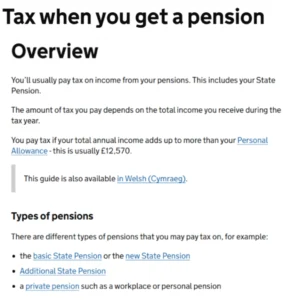
GOV.UK confirms that pension income, including the State Pension, is taxable when total income exceeds the available Personal Allowance.
Importantly, £12,570 is not an additional earnings allowance on top of a pension.
For example, someone receiving £10,000 annually from their State Pension would normally have only £2,570 of unused Personal Allowance available for taxable earnings from employment, assuming they have no other income or adjustments.
Once total income exceeds the allowance, tax is generally charged on the excess rather than the entire amount.
According to GOV.UK’s pension taxation guidance, State Pension and private pension payments are normally taxable, with the final liability determined by total annual income.
Which Sources of Income Count Towards a Pensioner’s Tax-Free Allowance?
Retirement income often comes from several sources rather than one monthly pension payment.
HMRC considers the different types of taxable income when determining an individual’s total annual liability.
| Income source | Usually taxable? | Important consideration |
| New or basic State Pension | Yes | Tax is not deducted directly |
| Additional State Pension | Yes | Added to other taxable income |
| Workplace pension | Yes | Usually taxed through PAYE |
| Private pension income | Yes | Tax-free lump sum rules may apply |
| Employment wages | Yes | Combined with taxable pension income |
| Self-employment profits | Yes | Tax based on taxable business profit |
| Rental profits | Yes | Tax applies after allowable deductions |
| Savings interest | Potentially | Separate savings allowances can apply |
| Dividends | Potentially | Dividend allowance and tax rates apply |
| ISA interest and investment gains | No | Normally exempt from Income Tax |
| Pension Credit | No | Tax-free benefit |
| Attendance Allowance | No | Tax-free benefit |
| Personal Independence Payment | No | Tax-free benefit |
One important distinction is between gross cash received and taxable income.
A retired landlord receiving £12,000 in annual rent does not necessarily have £12,000 of taxable rental profit. Allowable property expenses and applicable tax rules affect the calculation.
Similarly, a self-employed pensioner is normally taxed on taxable trading profits rather than total customer payments.
For retirement planning, the most reliable approach is to calculate each income stream separately before combining the relevant taxable amounts.
Does the State Pension Alone Exceed the Tax-Free Allowance?
For the 2026/27 tax year, the full new State Pension is £241.30 per week.
Multiplying this weekly rate by 52 produces an annualised amount of £12,547.60.
| State Pension measure | Amount |
| Full new State Pension, weekly rate | £241.30 |
| Weekly rate multiplied by 52 | £12,547.60 |
| Standard annual Personal Allowance | £12,570 |
| Difference | £22.40 |
On this straightforward annualised comparison, the full new State Pension remains slightly below the Personal Allowance.
However, HMRC’s actual calculation for a full tax year can differ because State Pension rates change in April.
For people who started receiving their State Pension after 5 April 2010, HMRC normally calculates annual taxable entitlement using one week at the previous rate and 51 weeks at the uprated amount.
Using the full new State Pension rates:
- One week at the previous £230.25 rate: £230.25
- Fifty-one weeks at the 2026/27 rate of £241.30: £12,306.30
- Total taxable State Pension entitlement: £12,536.55
This leaves £33.45 below the standard Personal Allowance for a pensioner with that precise entitlement and no other taxable income.
The distinction matters because HMRC calculates State Pension taxation using entitlement within the tax year rather than simply adding up the dates and amounts of bank payments.
Someone receiving Additional State Pension, protected payments, deferred pension increases or other taxable income can have a different liability.
The payment timetable also creates confusion. The State Pension is generally paid every four weeks, and the dates payments arrive do not necessarily match the tax-year entitlement calculation.
Understanding how State Pension payments are made in arrears can help pensioners reconcile their bank statements with HMRC’s figures.
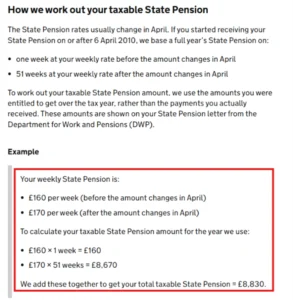
HMRC explains how taxable State Pension entitlement is calculated using the weekly rates before and after the annual April increase.
How Much Can a Pensioner Earn From Work Without Paying Tax?
There is no legal earnings ceiling that prevents a pensioner from continuing to work.
A person can receive their State Pension and earn employment income simultaneously, provided they have reached the relevant qualifying age and meet the pension’s requirements.
However, earnings are added to pension income for Income Tax purposes.
Consider a pensioner receiving £9,000 annually from the State Pension.
If they earn another £3,000 from employment, total taxable income is £12,000. No Income Tax is normally due.
If the same pensioner earns £6,000 from work, total taxable income rises to £15,000.
Their basic-rate Income Tax calculation becomes:
£15,000 − £12,570 = £2,430 taxable income
£2,430 × 20% = £486 annual Income Tax
The important financial point is that the tax is charged on the income above the allowance, not on all £15,000.
Examples of Pensioners’ Income Tax in 2026/27
| Annual State Pension | Other taxable income | Total income | Income Tax |
| £9,000 | £3,000 wages | £12,000 | £0 |
| £9,000 | £6,000 wages | £15,000 | £486 |
| £11,000 | £6,000 private pension | £17,000 | £886 |
| £12,536.55 | £2,000 wages | £14,536.55 | £393.31 |
| £0 | £20,000 private pension | £20,000 | £1,486 |
| £0 | £31,000 wages and pension | £31,000 | £3,686 |
These are illustrative calculations for England, Wales and Northern Ireland, assuming the standard Personal Allowance, only ordinary employment and pension income, and no additional reliefs or adjustments. Scottish calculations may differ.
For pensioners returning to work, forecasting total income for the tax year is particularly important.
Someone working only a few hours per week may still pay Income Tax if pension payments have already used nearly all of their Personal Allowance.
Equally, someone retiring halfway through a tax year must account for earnings received earlier in that same tax year. Retirement does not reset the annual allowance.
Do Pensioners Pay the Same Income Tax Rates Across the UK?
The standard Personal Allowance is UK-wide, but Scottish taxpayers have different rates and bands on pension income and employment earnings.
England, Wales and Northern Ireland
For 2026/27, the main rates for ordinary taxable earnings and pensions are:
| Total annual taxable income, assuming standard allowance | Tax rate |
| Up to £12,570 | 0% |
| £12,571–£50,270 | 20% |
| £50,271–£125,140 | 40% |
| Above £125,140 | 45% |
The Personal Allowance is gradually withdrawn when adjusted net income exceeds £100,000, which can affect the tax due within these ranges.
Scotland
| Total annual income, assuming standard allowance | Scottish tax rate |
| Up to £12,570 | 0% |
| £12,571–£16,537 | 19% |
| £16,538–£29,526 | 20% |
| £29,527–£43,662 | 21% |
| £43,663–£75,000 | 42% |
| £75,001–£125,140 | 45% |
| Above £125,140 | 48% |
Scottish taxpayers therefore need to use their own tax bands when estimating the cost of additional employment or pension income.
Scottish rates apply to most non-savings income, including pensions and wages, while savings interest and dividends follow the relevant UK-wide tax rules.
For pensioners with several income sources, applying the correct regional rates is essential to producing a meaningful tax forecast.
What Will Change for Pensioners From April 2027?
A significant development is the introduction of the Pension Tax Allowance from 6 April 2027.
The government announced this measure to prevent some people reaching State Pension age from facing small Income Tax bills solely because of State Pension increases.
The standard Personal Allowance will remain £12,570 for 2027/28, but eligible pensioners can receive an additional Income Tax reduction.
The full annual value of the new State Pension for 2027/28 is expected to be £13,036.40 under the published government figures.
| 2027/28 annual income | Pension Tax Allowance treatment |
| Below £12,570 | Normally no Income Tax liability under the standard allowance |
| £12,570–£13,036.40 | Eligible pensioners receive full Pension Tax Allowance relief |
| Above £13,036.40 but below £13,319 | Partial relief may apply |
| £13,319 or more | No Pension Tax Allowance relief |
The full Pension Tax Allowance is worth up to approximately £94 in 2027/28.
The relief reduces as income rises above the annual value of the full new State Pension, disappearing when income reaches the government’s stated withdrawal threshold.
Crucially, the Pension Tax Allowance:
- Applies to eligible people who are above State Pension age or reach it within the relevant tax year.
- Can apply even where income comes from private pensions, employment or other sources rather than the State Pension alone.
- Is an Income Tax reduction, not an increase in the ordinary Personal Allowance.
- Is expected to be applied automatically using HMRC’s available information.
- Cannot be transferred to a spouse or civil partner.
For example, an eligible pensioner with £13,000 of ordinary taxable income in 2027/28 would normally have £430 above the Personal Allowance. At the 20% basic rate, this would produce £86 in Income Tax before the new relief.
The Pension Tax Allowance would cover that amount, reducing the Income Tax bill to zero, assuming the individual satisfies the scheme’s conditions and has no other complicating tax liabilities.
This is particularly relevant because the full new State Pension will exceed the standard Personal Allowance from April 2027.
The measure does not permanently exempt pensions from taxation. Pensioners with higher total incomes will continue paying Income Tax according to the applicable rates.
The government’s Pension Tax Allowance explainer provides the eligibility criteria, withdrawal thresholds and examples.
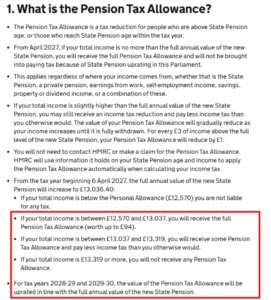
Government guidance confirms the new Pension Tax Allowance, the £13,036.40 income threshold and the relief available to eligible pensioners from April 2027.
Do Pensioners Have to Pay National Insurance If They Continue Working?
Income Tax and National Insurance are different deductions.
Most people stop paying employee National Insurance contributions when they reach State Pension age, even if they continue working.
This means an employee over State Pension age may still pay Income Tax on their wages but normally does not pay employee National Insurance.
For example, consider an employee aged above State Pension age with a taxable salary of £20,000 and no pension or other taxable income.
Using the standard allowance:
- Annual employment income: £20,000
- Personal Allowance: £12,570
- Income subject to basic-rate Income Tax: £7,430
- Income Tax at 20%: £1,486
- Employee National Insurance after State Pension age: Normally £0
This distinction can improve the take-home earnings available from part-time retirement work.
For self-employed pensioners, the rules differ slightly. Class 4 National Insurance normally stops from 6 April following the date the person reaches State Pension age. Income Tax can still apply to their business profits.
Self-employed pensioners should also check whether they continue to meet Self Assessment requirements.
How Much of a Private Pension Can Be Taken Tax-Free?
A private or workplace defined contribution pension has different rules from the State Pension.
Generally, individuals can take up to 25% of the value of their pension benefits as a tax-free lump sum, subject to their available lump sum allowance.
For most people, the standard lump sum allowance is £268,275, although protected allowances or previous withdrawals can alter the position.
Consider someone with a pension pot worth £80,000.
| Withdrawal component | Amount |
| Total pension pot | £80,000 |
| Potential tax-free 25% | £20,000 |
| Remaining pension value | £60,000 |
The £20,000 tax-free lump sum does not use the individual’s standard Personal Allowance.
The remaining £60,000 is not automatically taxed all at once. Tax depends on how and when the person accesses the money.
If the entire taxable balance is withdrawn within one tax year, it could create a substantial Income Tax bill and push the individual into a higher tax band.
By contrast, spreading taxable withdrawals across different tax years can sometimes reduce the total tax cost, depending on income needs, pension scheme rules and future tax changes.
A critical consideration is that taking taxable flexible pension income can trigger the Money Purchase Annual Allowance, restricting tax-efficient future contributions to certain defined contribution pensions.
Any decision to access pension savings should therefore consider future income needs and potential tax consequences, rather than the immediate amount of tax-free cash alone.
Do Pensioners Pay Tax on Savings Interest and ISA Income?
Pensioners may be able to receive additional savings income without paying tax because savings have their own tax allowances.
For 2026/27, the Personal Savings Allowance is generally:
| Taxpayer category | Personal Savings Allowance |
| Basic-rate taxpayer | £1,000 |
| Higher-rate taxpayer | £500 |
| Additional-rate taxpayer | £0 |
There is also a starting rate for savings that can allow up to £5,000 of savings interest to be taxed at 0%.
This allowance is reduced by £1 for every £1 of non-savings income above the Personal Allowance. It is unavailable when the relevant non-savings income reaches £17,570.
For example, a pensioner with £12,000 of pension income and £1,000 of savings interest would not normally pay Income Tax, assuming no other income or adjustments.
Their unused Personal Allowance and savings reliefs can cover the relevant interest.
Pensioners should not assume every pound of savings interest automatically creates a tax bill.
However, savings interest still matters when determining tax bands and eligibility for certain reliefs, including the new Pension Tax Allowance from 2027.
Interest and investment returns generated within qualifying ISAs are normally exempt from Income Tax and do not count towards the Pension Tax Allowance income calculation.
For someone relying on savings during retirement, holding suitable assets inside tax-efficient accounts can therefore improve long-term after-tax income.
How Does HMRC Collect Income Tax From Pensioners?
HMRC can collect tax through different mechanisms depending on the types of income someone receives.
PAYE Through a Workplace or Private Pension
Most workplace and private pension providers use Pay As You Earn.
Where an individual receives a State Pension alongside a private pension or salary, HMRC may adjust the tax code attached to the taxable PAYE income.
The State Pension itself is normally paid without tax being deducted.
For example, a pensioner receiving a State Pension and a workplace pension may find that their workplace pension tax code has been reduced.
This can occur because HMRC is accounting for untaxed State Pension income.
A reduced tax code does not necessarily mean the pension provider has made a mistake.
However, it is important to check whether the tax code is correct whenever a new pension starts or employment income changes.
Simple Assessment
Where someone has taxable State Pension income but no suitable PAYE income from which HMRC can collect the tax, HMRC may issue a Simple Assessment calculation.
The calculation explains the amount owed and how it should be paid.
This situation becomes particularly relevant when pension income exceeds the Personal Allowance but there is no workplace or private pension provider deducting tax.
Self Assessment
Some pensioners must complete Self Assessment returns, particularly where they have taxable self-employment income, certain property income or other circumstances requiring a return.
Their annual taxable State Pension entitlement and relevant private pension income must be included.
Tax Code Changes and Unexpected Deductions
A pensioner’s tax code may change following:
- An increase in State Pension entitlement.
- Starting or stopping employment.
- Receiving an additional workplace pension.
- Changes to estimated savings income.
- Adjustments to Marriage Allowance.
- Collection of tax owed from a previous year.
Some pensioners may receive a K code when untaxed income and other deductions exceed the amount of allowances available through their tax code.
This does not automatically indicate an HMRC error. Understanding why a K tax code may appear on pension income can help identify whether the underlying figures need correcting.
Pensioners should review their tax coding notices whenever income circumstances change and query inaccurate estimates promptly.
Can Pensioners Reduce the Amount of Income Tax They Pay?
There are several lawful ways pensioners can manage their Income Tax liability.
The most effective option depends on how income is generated, the pensioner’s age, available allowances and whether they have a spouse or civil partner.
1. Make full use of available allowances
Pensioners should check their eligibility for the standard Personal Allowance, savings reliefs, Blind Person’s Allowance and other applicable tax reliefs.
2. Consider Marriage Allowance
Eligible married couples and civil partners may transfer £1,260 of Personal Allowance from the lower-income partner to the higher-income partner.
This can reduce the recipient’s annual Income Tax bill by up to £252, provided the eligibility requirements are satisfied.
It does not create a separate £1,260 tax-free earnings allowance for both partners.
3. Plan the timing of private pension withdrawals
Large withdrawals may push income into higher tax bands. Smaller withdrawals across different tax years can sometimes help control taxable income, subject to financial needs and pension rules.
4. Review tax codes regularly
Incorrect estimated income can lead to excessive tax deductions. HMRC should be informed when pension or employment circumstances change.
5. Consider whether State Pension deferral is appropriate
Some individuals who are still working may consider deferring their State Pension rather than claiming it immediately.
Deferral can increase future State Pension payments, but it also means giving up payments during the deferral period.
It should not be treated as a guaranteed tax-saving strategy. The increased pension remains taxable, and the overall financial benefit depends on longevity, income, benefits and individual circumstances.
For pensioners approaching a higher tax bracket, planning taxable income before making a withdrawal can be more effective than attempting to recover overpaid tax afterwards.
What Are the Most Common Pensioner Tax Mistakes?
Several misunderstandings can result in an incorrect retirement tax calculation.
| Common misunderstanding | Correct position |
| Pensioners never pay Income Tax | Tax can apply when total taxable income exceeds allowances |
| A pensioner can earn £12,570 on top of the State Pension tax-free | Pension income generally uses the same Personal Allowance |
| State Pension is automatically taxed before payment | DWP normally pays State Pension without deducting Income Tax |
| Everyone over 65 pays no National Insurance | The exemption is linked to State Pension age and the relevant contribution rules |
| All private pension withdrawals are tax-free | Usually only the qualifying tax-free portion is exempt |
| The Personal Allowance rises to £13,036.40 in 2027 | The standard allowance remains £12,570; a separate tax reduction is being introduced |
| Every pensioner must file a Self Assessment return | Many people have tax handled through PAYE or Simple Assessment |
The most financially significant mistake is treating State Pension, employment earnings and private pensions as if each source has a separate £12,570 allowance.
In reality, HMRC calculates the individual’s total tax liability using the applicable allowances and rates.
Frequently Asked Questions
How much can a pensioner earn tax-free in the UK in 2026/27?
A pensioner can normally receive up to £12,570 in total taxable income annually before paying Income Tax, including State Pension, private pensions and employment earnings.
Can pensioners work and still receive their State Pension?
Yes, pensioners can continue working while receiving their State Pension. However, their wages and taxable pension income are combined when calculating Income Tax.
Do pensioners pay tax on part-time earnings?
Yes, if their combined taxable income exceeds the £12,570 Personal Allowance. Even small part-time earnings may be taxable when pension income has already used the allowance.
Do pensioners pay National Insurance after retirement?
Employees generally stop paying National Insurance when they reach State Pension age, although they may still pay Income Tax on their earnings.
How much State Pension can you receive before paying tax?
The full new State Pension is £241.30 per week in 2026/27, below the £12,570 annual Personal Allowance on a 52-week comparison. Additional taxable income may trigger tax.
Will pensioners pay Income Tax from April 2027?
Eligible pensioners with income up to £13,036.40 in 2027/28 will benefit from the new Pension Tax Allowance, potentially reducing their Income Tax liability to zero.
How can pensioners avoid paying unnecessary Income Tax?
Pensioners can use eligible tax allowances, review HMRC tax codes, manage private pension withdrawals carefully and consider tax-efficient savings such as ISAs.
What is your reaction?