How To Reduce Business Rates On An Empty Property Legally?

Last Updated: 27 October 2026
Keeping a commercial property empty can quickly become expensive once the initial rate-free period ends.
Business rates can continue to apply even when a shop, office, warehouse or other commercial building is producing no rental income.
There are, however, legitimate ways to reduce or temporarily remove the liability.
Understanding how to avoid business rates on empty property legally means knowing when Empty Property Relief applies, which properties receive longer exemptions, how reoccupation affects relief and when a property’s rateable value may be reduced or removed.
The rules below mainly cover England. Scotland and Wales operate different arrangements in several important areas.
When Do Business Rates Start On A Vacant Commercial Property?
Most empty commercial properties in England receive 100% Empty Property Relief for the first three months after becoming vacant.
After that period, full business rates generally become payable unless the property qualifies for another exemption.
Qualifying industrial premises receive a longer initial period of six months. This can include certain warehouses and factories.
Business rates apply to non-domestic property and should not be confused with residential Council Tax. Different rules determine eligibility for Council Tax exemptions.
The basic position for empty properties is:
| Property Type Or Circumstance | Empty Property Rates Position |
| Most Shops And Offices | No business rates for the first 3 months |
| Qualifying Industrial Premises | No business rates for the first 6 months |
| Listed Buildings | Exempt while empty until reoccupied |
| Property With Rateable Value Below £2,900 | Exempt while empty until reoccupied |
| Qualifying Charity Property | May remain exempt where the next use will mainly be charitable |
| Qualifying CASC Property | May remain exempt where the next use will mainly be as a sports club |
| Most Other Empty Properties After Relief Ends | Full business rates normally become payable |
GOV.UK confirms that Empty Property Relief begins when the property becomes empty and that most businesses must pay full rates after the applicable relief period ends.
How Empty Property Relief Works In 2026?
Empty Property Relief gives owners and other liable ratepayers a period in which they can market, repair or prepare a vacant commercial property without immediately facing a full business rates bill.
Three-Month Empty Property Relief
Most non-industrial commercial properties qualify for a three-month rate-free period after becoming empty.
This commonly covers premises such as:
- Retail Shops: Standard vacant retail premises will normally receive the initial three-month period
- Office Buildings: Empty offices generally receive three months before full rates become payable
- Leisure Premises: Vacant qualifying non-industrial leisure premises usually follow the standard three-month period
- Other Commercial Units: Most non-industrial business premises follow the same initial rule
The relief relates to the property rather than simply to the owner. Purchasing or leasing a building that has already used its empty property relief does not normally create a completely new relief period.
Local authority guidance confirms that a change in ownership or tenancy does not restart the exemption.
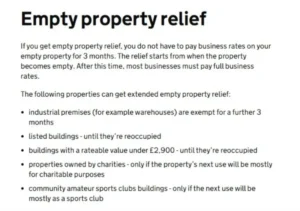
GOV.UK confirms the standard three-month relief period, extended industrial relief and continuing exemptions for qualifying properties.
Six-Month Relief For Industrial Properties
Qualifying industrial properties receive six months without business rates rather than three.
This can include properties such as warehouses, factories and certain workshops where they meet the relevant definition of industrial premises.
Once the six-month period ends, full rates generally become payable unless another exemption applies.
GOV.UK describes this as the normal three-month relief followed by an additional three months for qualifying industrial premises.
Properties That Can Remain Exempt
Certain empty properties can continue receiving relief after the normal three or six-month period.
These include:
- Listed Buildings: Empty listed buildings can remain exempt until they are occupied again
- Low-Value Properties: Empty properties with a rateable value below £2,900 can remain exempt
- Charity Properties: Relief may continue where the property’s next use will mainly be for charitable purposes
- Community Amateur Sports Clubs: Relief may continue where the building’s next use will mainly be as a qualifying sports club
The £2,900 threshold continues to apply to the 2026 rating list in England.
Legal Ways To Reduce Business Rates On Empty Property
Avoiding business rates legally is mainly about using the reliefs, valuation procedures and exemptions that already exist rather than creating artificial arrangements.
Claim Empty Property Relief
The first step should be to notify the local council when the property becomes vacant.
Do not assume the council will automatically have all the information required to calculate the relief correctly. The council may need the vacancy date and evidence showing when occupation ended.
Keep records including:
- Lease Documents: Keep copies showing when a tenant’s right to occupy started or ended
- Vacancy Evidence: Keep dated photographs and property records
- Utility Records: Retain relevant meter readings or account information
- Property Correspondence: Keep communications with tenants, agents and the council
- Rates Bills: Keep previous and revised bills showing the relief applied
Businesses managing several properties may find it useful to maintain these records through suitable small business accounting software so rates bills, property costs and relief periods are easier to track.
Use Section 44A Relief For Partly Occupied Properties
A property does not always need to be completely empty for some relief to become available.
Where a building is temporarily only partly occupied, a local authority may be able to grant relief for the unoccupied section. This is commonly referred to as Section 44A relief.
It can be relevant where:
- One Floor Is Empty: A business may occupy one part of an office while another floor remains unused
- Warehouse Space Is Temporarily Unused: Part of an industrial property may be vacant during restructuring
- Occupation Is Being Phased: A tenant may gradually move into or out of a building
- Temporary Works Restrict Use: Part of the premises may be unavailable for a short period
This relief is discretionary. GOV.UK states that councils may provide a temporary reduction when a property is partly empty, with relief applying to the empty portion where eligibility requirements are satisfied.
Reduce Or Challenge The Rateable Value
The amount of business rates due is closely connected to the property’s rateable value.
If the rateable value appears incorrect, the ratepayer can use the Valuation Office process to check the valuation and, where appropriate, challenge it.
A lower rateable value can reduce the basic business rates liability. It may also affect which multiplier or relief applies.
Property owners should not assume that a building being empty automatically means its rateable value becomes zero. Vacancy alone does not normally remove a property from the rating list.
Remove An Unusable Property From The Rating List
There are situations where a property can potentially have its rateable value reduced or be deleted from the rating list.
The Valuation Office Agency says this may be considered where a property or part of it is:
- In Serious Disrepair: The cost and nature of repair may make normal occupation economically unrealistic
- Under Major Reconstruction: Substantial redevelopment may make the existing property incapable of occupation
- Being Demolished: Removal can normally take effect once demolition work actually begins
- Physically Changed: Major structural work can affect whether the existing assessment remains appropriate
A planned refurbishment or planning permission alone does not automatically remove the rates liability.
The VOA assesses individual cases and may require photographs, contractor invoices, schedules of work, surveys, plans and evidence showing when physical work started.
Claim Relief During Major Refurbishment Or Repairs
An empty property undergoing ordinary decoration is not automatically exempt from rates.
However, where repairs or refurbishment make the building genuinely incapable of use, the VOA may decide that business rates are not payable while it remains unusable.
GOV.UK advises ratepayers to tell the Valuation Office when a building cannot be used because it is being repaired or refurbished. The property and the works are then assessed to determine whether rates should continue.
The distinction is important. Repainting an empty office is very different from major structural reconstruction that prevents occupation.
How The 13-Week Reoccupation Rule Works?
Reoccupation can create a new Empty Property Relief period, but simply placing someone in the property for a very short time is not enough.
For property becoming empty under the current English rules, the building generally needs to have been genuinely occupied continuously for 13 weeks or more before another three or six-month Empty Property Relief period becomes available.
The reset period increased from six weeks to 13 weeks from 1 April 2024.
The government describes the 13 weeks as the reset period. If the property is properly occupied for the required period and later becomes vacant again, it may qualify for a fresh period of Empty Property Relief.
The key issue is genuine occupation. A normal tenant operating a real business from the premises is very different from arrangements created solely to generate another period of rates relief.
Business Rates Avoidance Rules And The 2026 Box-Shifting Court Decision
A major development in 2026 changed how certain artificial occupation arrangements are viewed.
The Court of Appeal considered a business rates arrangement known as box shifting, where boxes and files were placed inside otherwise empty offices with the intention of creating occupation and triggering another period of Empty Property Relief.
In The Mayor and Commonalty and Citizens of the City of London v 48th Street Holdings Limited & Anor [2026] EWCA Civ 970, the Court of Appeal concluded that placing boxes in the premises did not amount to occupation for rating purposes where the sole objective was to generate rates mitigation.
The Ministry of Housing, Communities and Local Government subsequently told local authorities to consider whether similar arrangements should continue to be recognised and to withdraw relief where they conclude that genuine occupation has not taken place.
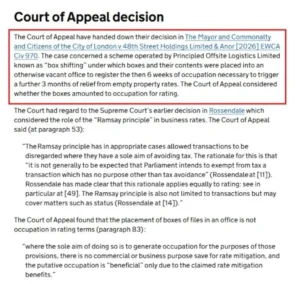
The September 2026 government letter confirms that the Court of Appeal rejected the box-shifting arrangement as occupation for rating purposes.
Property owners should therefore be cautious about arrangements promoted as easy business rates loopholes.
A stronger approach is to rely on genuine commercial occupation, statutory reliefs, accurate valuations and properly evidenced refurbishment or redevelopment.
Who Pays Business Rates When A Commercial Property Is Empty?
Liability does not automatically fall on the landlord every time a tenant physically leaves the building.
For an empty commercial property, the person entitled to possession will generally be liable.
This will often be the leaseholder where an existing lease remains in force. If no tenant or leaseholder retains the right to possession, liability will commonly fall back to the freeholder or owner.
For example:
| Situation | Person Normally Responsible |
| Tenant Occupies Under An Active Lease | Tenant |
| Tenant Vacates But Still Holds The Lease | Tenant May Remain Liable |
| Lease Ends And Property Remains Empty | Landlord Or Freeholder Usually Becomes Liable |
| New Tenant Takes Possession | New Occupier Normally Becomes Liable |
| Property Is Sold While Empty | Liability Moves With The Relevant Right To Possession, But The Relief Clock Does Not Automatically Restart |
When purchasing or disposing of commercial property, liability dates should be checked carefully against the lease and completion documents.
Professional support may also be useful where property ownership is transferring, including advice from appropriate conveyancing solicitors in the UK.
How Much Are Business Rates On Empty Property In 2026/27?
Once Empty Property Relief ends, the bill depends largely on the property’s rateable value, the applicable multiplier and any remaining relief.
A simplified calculation is:
Rateable Value × Business Rates Multiplier = Basic Annual Business Rates
The actual bill may then be affected by transitional arrangements or other applicable relief.
2026 Business Rates Revaluation
A new business rates revaluation came into effect in England and Wales on 1 April 2026.
The new rateable values are based on estimated open-market rental values as at 1 April 2024.
This means property owners should not automatically use an old rateable value when estimating the cost of leaving a building vacant. The current value can be checked through the Valuation Office service.
2026/27 Business Rates Multipliers
For England, the main 2026/27 multipliers include:
| Rateable Value And Property Type | Multiplier |
| Non-RHL Property Below £51,000 RV | 43.2p |
| Non-RHL Property From £51,000 To £499,999 RV | 48.0p |
| Property With RV Of £500,000 Or More | 50.8p |
| Qualifying Occupied RHL Property Below £51,000 RV | 38.2p |
| Qualifying Occupied RHL Property From £51,000 To £499,999 RV | 43.0p |
The government confirmed these multipliers for the 2026/27 tax year.
For example, consider an empty non-RHL office with a rateable value of £30,000.
Using the 43.2p multiplier gives a basic annual figure of:
£30,000 × 0.432 = £12,960
If the office became empty at the beginning of the rating year and received the normal three-month Empty Property Relief, a simple nine-month illustration would be approximately £9,720 before any other adjustments.
The exact council calculation can differ because liability is calculated for the relevant chargeable days and other reliefs or transitional arrangements may apply.
Empty Retail, Hospitality And Leisure Properties
England introduced permanently lower business rates multipliers for qualifying retail, hospitality and leisure properties from 1 April 2026.
However, there is an important rule for empty properties.
The lower RHL multipliers apply to qualifying occupied properties.
Government guidance states that an unoccupied property reverts to the relevant national multiplier once Empty Property Relief ends, even where the building is intended to be used for retail, hospitality or leisure in the future.
This means an empty shop, restaurant or hotel should not automatically be budgeted using the lower occupied RHL multiplier.
Do Empty Property Business Rates Rules Differ Across The UK?
Yes. Business rates are devolved, so property owners should not apply the English rules automatically to premises elsewhere in the UK.
England
England generally provides:
- Standard Relief: Three months for most empty commercial properties
- Industrial Relief: Six months for qualifying industrial premises
- Reset Period: 13 weeks of continuous genuine occupation before a fresh period can normally begin
- Low-Value Exemption: Continuing exemption for empty properties with an RV below £2,900
- Additional Exemptions: Listed buildings and qualifying charity or CASC properties can receive longer exemptions
Scotland
Scotland operates differently.
Empty Property Relief was devolved to individual local authorities from 1 April 2023.
Councils can therefore design local relief arrangements for vacant properties rather than following one standard Scotland-wide Empty Property Relief scheme.
A landlord or business with property in Scotland should check the specific council’s current policy before assuming that an English three or six-month rule applies.
Wales
Wales retains its own non-domestic rates rules.
Business Wales states that qualifying empty properties generally receive three months of initial relief, increasing to six months for qualifying industrial premises.
However, a property normally needs to have been occupied for more than 26 weeks immediately beforehand to qualify for a fresh initial relief period. This is significantly longer than England’s 13-week reset requirement.
The low-value exemption threshold in Wales also differs from England.
How To Claim Empty Property Relief?
The practical process usually starts with the local billing authority rather than HMRC.
A property owner, tenant or other liable party should:
- Notify The Local Council: Tell the council when the commercial property became vacant
- Confirm The Vacancy Date: Provide the date occupation ended and supporting evidence where requested
- Check The Rateable Value: Confirm the property’s current 2026 rating list value
- Identify The Relief Period: Establish whether the property receives three months, six months or a continuing exemption
- Check Previous Occupation: Confirm whether the 13-week reset requirement has been met where a fresh period of relief is being claimed
- Apply For Partly Occupied Relief: Contact the council promptly if only part of the building is temporarily empty
- Report Major Building Works: Contact the VOA where reconstruction, serious disrepair or refurbishment makes occupation impossible
- Keep Supporting Records: Retain photographs, leases, invoices, plans, bills and correspondence
- Report Changes Quickly: Tell the council when the property becomes occupied again or other relevant circumstances change
Landlords who also receive taxable property income should keep business rates records alongside their wider tax documentation. From April 2026, some landlords and sole traders are also affected by the phased Making Tax Digital changes.
Frequently Asked Questions
How Long Can A Commercial Property Be Empty Without Paying Business Rates?
Most qualifying commercial properties in England receive three months without business rates after becoming empty. Qualifying industrial premises generally receive six months. Longer exemptions apply to certain properties.
Does Empty Property Relief Restart After Reoccupation?
It can, but the property generally needs to have been genuinely occupied continuously for at least 13 weeks before becoming empty again.
Short artificial occupation should not be treated as an automatic way to restart relief.
Does Selling An Empty Property Restart The Relief Period?
No. A change in ownership or tenancy does not normally restart the empty property relief clock. If the previous relief period has already expired, the new owner may become liable for empty property rates immediately.
Can You Avoid Business Rates While Renovating A Property?
Possibly, but renovation alone is not enough. If the VOA determines that repair or refurbishment makes the property incapable of use, business rates may not be payable until it becomes usable again.
Can Part Of A Property Qualify For Empty Property Relief?
A local council may grant temporary relief where only part of a property is empty. This is commonly handled through Section 44A and is discretionary rather than automatic.
Who Pays Business Rates If A Tenant Leaves Before The Lease Ends?
A tenant may remain liable if they still hold the lease and remain the person entitled to possession. The physical act of moving out does not necessarily transfer liability immediately to the landlord.
Do Empty Shops Get Retail Business Rates Relief?
The new lower retail, hospitality and leisure multipliers introduced in England from April 2026 apply to qualifying occupied properties.
An empty property normally moves to the applicable national multiplier after Empty Property Relief ends.
Are Listed Buildings Exempt From Empty Property Business Rates?
In England, empty listed buildings can receive extended Empty Property Relief until they are reoccupied.
What is your reaction?