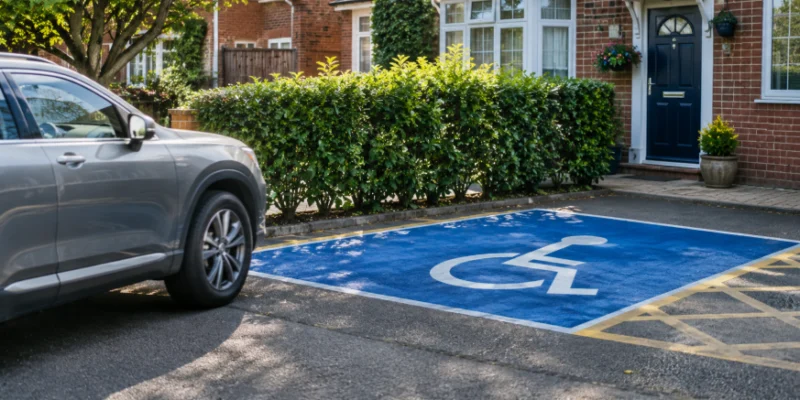
My Neighbour Has a Disabled Parking Bay – Can I Use It in the UK?

Last Updated – 11-11-2026
Finding a parking space outside your home can be frustrating, particularly on busy residential streets.
If your neighbour has a disabled parking bay outside their property, you might wonder whether you can legally use it when their car is not there.
The short answer is that you may be legally allowed to park in your neighbour’s disabled parking bay if it is advisory.
However, if the bay is legally enforceable, you normally need a valid Blue Badge or the specific permit required by the parking restriction.
In the UK, disabled parking bays do not automatically belong to the person who requested them. However, some are protected by legal parking restrictions, while others rely on the consideration of nearby drivers.
Understanding this difference can help you avoid parking penalties, disagreements with neighbours and unnecessary complaints.
Can I Park in My Neighbour’s Disabled Parking Bay?
Whether you can use your neighbour’s disabled parking space depends mainly on the type of bay and the restrictions applying to it.
There are three important categories:
- Advisory disabled parking bays: Generally not legally enforceable on their own. Other drivers may park there, although they are encouraged to leave the space available for disabled residents.
- Enforceable disabled parking bays: Usually restricted to vehicles displaying valid Blue Badges. Drivers without the required badge may receive a parking penalty.
- Personalised disabled parking bays: Some councils provide spaces reserved for a specific permit holder. An ordinary Blue Badge may not be enough to use these spaces.
The bay’s location outside your neighbour’s house does not, by itself, establish who has permission to park there.
Our review of UK council guidance highlights why checking the actual parking restriction is more reliable than assuming every wheelchair-marked bay has the same legal status.
Disabled Parking Bay Rules at a Glance
| Situation | Can you legally park there? |
| Advisory bay without a Blue Badge | Generally yes, if no other restriction applies |
| Enforceable bay without a Blue Badge | Normally no |
| Enforceable bay with your own valid Blue Badge | Usually yes, subject to conditions |
| Personalised bay with another person’s permit number | No, unless you hold the required permit |
| Advisory bay while your neighbour is away | Generally yes, but consider their future access needs |
| Enforceable bay with your neighbour’s permission but no badge | Normally no |
| Disabled bay on private property | Depends on the property’s parking rules |
These distinctions apply to the bay itself. Other restrictions, including obstruction, dropped kerbs or controlled parking zones, can still affect whether parking is lawful.
What Is the Difference Between an Advisory and an Enforceable Disabled Parking Bay?
The difference between these two arrangements is central to residential parking disputes.
An advisory disabled parking bay is marked on the road to encourage drivers to leave the space available for someone with limited mobility.
It is generally created without a Traffic Regulation Order establishing an enforceable restriction for that bay.
For example, Bristol City Council explains that its advisory disabled bays do not have legal standing and can be used by other motorists, although drivers who do not need accessible parking are asked to use another space.
An enforceable disabled parking bay, by contrast, is supported by a legal parking restriction, typically established through a Traffic Regulation Order (TRO).
This enables parking enforcement officers to issue Penalty Charge Notices when motorists park in breach of the restriction.
An important practical point is that enforcement depends on the legal restriction, not simply whether the road marking appears official.
How Can You Tell Whether the Bay Is Enforceable?
Look for an upright parking sign identifying the space as reserved for disabled badge holders, any permit identifier and restrictions on operating times.
However, signage alone should not be treated as a definitive test. Some lawful restrictions may operate without an individual upright sign, and the absence of a sign does not automatically confirm that parking is unrestricted.
The most reliable way to establish the position is to ask the relevant council or roads authority whether the bay is covered by an enforceable Traffic Regulation Order.
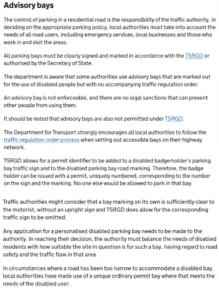
Advisory and enforceable disabled parking bays explained in the Department for Transport’s official guidance.
Does My Neighbour Own the Disabled Parking Bay Outside Their House?
Usually, no.
When a council installs a disabled parking bay on a public road, it does not normally transfer ownership of the space to the resident who requested it.
A neighbour may have applied for the bay because they have a disability, experience serious difficulty walking or need parking close to their home.
Nevertheless, an ordinary enforceable disabled bay is generally available to anyone with a valid Blue Badge, not exclusively the person who originally applied.
Ayrshire Roads Alliance confirms that residential disabled bays do not belong to individual applicants and can be used by other qualifying Blue Badge holders.
There is, however, an important exception.
Some councils operate personalised disabled parking schemes in which a bay is allocated to a specific permit holder. These may be marked with an identifying number that corresponds to a permit.
In such circumstances, the parking restriction may prevent even other Blue Badge holders from using the space.
Therefore, your neighbour does not automatically own a public roadside parking space, but a legally designated bay may still be reserved for their exclusive permit use.
Can I Use My Neighbour’s Disabled Bay If I Have a Blue Badge?
In most ordinary disabled parking bays, yes, provided your Blue Badge is valid, displayed correctly and being used for a permitted journey.
A Blue Badge is issued to an individual rather than a particular vehicle. This means the badge holder can use it while driving or travelling as a passenger in different vehicles.
For example, imagine two neighbours living on a residential street in Birmingham.
One resident has successfully applied for a legally designated disabled parking bay outside their house. Another resident also holds a valid Blue Badge and struggles with mobility.
Provided the bay is open to Blue Badge holders generally, the second resident would normally be allowed to park there.
The first resident cannot automatically prevent another qualifying badge holder from using the space simply because they applied for it.
However, you should always check whether a specific permit restriction or time limit applies.
Can a Family Member Use Someone Else’s Blue Badge?
Not simply because the badge holder is related to them.
A family member can display the badge when transporting the badge holder or collecting or dropping them off in circumstances permitted by the scheme.
They cannot use the badge to gain parking privileges for their own unrelated journeys.
For instance, borrowing your parent’s Blue Badge to park outside your neighbour’s house while you visit friends would be misuse if your parent was not involved in the qualifying journey.
Deliberate Blue Badge misuse can result in prosecution and a fine of up to £1,000.
Can I Park in the Disabled Bay If My Neighbour Is Away?
Your neighbour being away does not automatically change the legal status of the parking space.
If the disabled bay is enforceable, it remains subject to its restrictions even when the person who requested it is on holiday, in hospital or staying elsewhere.
A driver without a Blue Badge should not assume that temporarily using an empty enforceable bay is acceptable.
If it is advisory, parking there may not breach a specific disabled-bay restriction, provided no other parking rules are broken.
However, residents should consider why the bay was introduced.
A disabled neighbour may return unexpectedly, require urgent transport or need access for a vehicle assisting with their mobility.
A useful distinction is between what parking regulations permit and what considerate neighbourhood behaviour requires.
Even if using an advisory bay is lawful, consistently occupying it can defeat the reason the council marked the space.
Can I Be Fined for Parking in My Neighbour’s Disabled Bay?
Yes, if you breach an enforceable parking restriction.
The possibility of receiving a penalty depends on the bay’s legal status, the relevant authority and the circumstances.
| Type of parking bay | Enforcement position | Possible consequence |
| Advisory disabled bay | No enforceable restriction arising solely from the advisory marking | Normally no penalty solely for using that marking |
| TRO-backed disabled bay | Enforceable | Penalty Charge Notice |
| Personalised permit bay | Enforceable where legally designated | Penalty for parking without the required permit |
| Private disabled parking space | Governed by relevant private parking arrangements | Parking charge or other contractual consequences |
| Bay overlapping another parking restriction | Other restrictions may still apply | Penalty depending on the contravention |
The amount payable is not a single nationwide figure. It depends on the applicable parking enforcement regime and any discount or appeal provisions.
Drivers should also understand that parking for only five or ten minutes does not create an automatic exemption from disabled-bay restrictions.
Likewise, your neighbour cannot authorise you to ignore an enforceable public-road restriction simply by giving verbal permission.
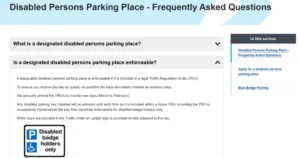
Ayrshire Roads Alliance confirms when residential disabled parking bays become legally enforceable.
How Do Disabled Parking Bay Rules Differ Across the UK?
Although the Blue Badge scheme operates throughout the UK, parking administration and enforcement are not identical in every nation or local authority.
| UK nation | Important consideration |
| England | Councils may have advisory bays, enforceable bays or personalised permit arrangements |
| Scotland | The Disabled Persons’ Parking Places (Scotland) Act 2009 aims to make disabled bays enforceable, although temporary advisory bays can exist |
| Wales | Local authorities determine residential parking restrictions, including advisory and enforceable arrangements |
| Northern Ireland | Accessible roadside parking bays are generally reserved for Blue Badge holders and enforced through the relevant parking system |
In Scotland, the 2009 legislation requires authorities to take steps towards making appropriate disabled parking bays enforceable.
However, new bays may initially operate on an advisory basis while the necessary legal process is completed.
In Northern Ireland, accessible parking bays are administered through the Department for Infrastructure, and drivers without the required Blue Badge can face enforcement.
Our analysis indicates that one of the most common sources of confusion is applying the policy of one council to an entirely different part of the UK.
A residential bay in Bristol may not have the same enforcement arrangements as one in Glasgow or Belfast.
Always check the rules for the exact road and local authority rather than relying on a general statement that all residential disabled parking bays are advisory.
What Should I Do If My Neighbour Says I Cannot Park There?
Parking disagreements between neighbours can escalate quickly, particularly where spaces are limited.
The first step is to establish whether your neighbour is referring to an enforceable restriction or asking you to respect an advisory marking.
If the bay is legally reserved for Blue Badge holders and you do not hold a valid badge, you should avoid parking there.
If it is advisory, you may be legally entitled to use the space, but that does not necessarily mean doing so regularly is a reasonable solution.
A practical approach is to explain that you were unsure of the parking arrangements and offer to check the rules with the local council.
You can also consider alternative spaces nearby, especially if your neighbour has substantial mobility difficulties.
Neither resident should assume that an argument over parking gives them permission to obstruct a vehicle, threaten another person or take matters into their own hands.
Can My Neighbour Report Me to the Council?
Yes. Anyone can report a suspected parking contravention.
However, reporting a vehicle does not guarantee enforcement.
The council must have an appropriate legal basis for issuing a penalty.
For an advisory disabled bay, a council will generally be unable to issue a penalty solely because a driver without a Blue Badge has occupied the marking.
For an enforceable bay, the parking authority may investigate and take action.
How Can I Check Whether the Disabled Parking Bay Has a Traffic Regulation Order?
A Traffic Regulation Order is one of the key documents used to establish enforceable on-street parking restrictions.
If you are uncertain about your neighbour’s bay, follow these steps.
Step 1: Identify the relevant authority
Find out which council or roads authority manages parking restrictions on your street.
Step 2: Check the road markings and nearby signs
Take note of the exact location, any disabled badge symbol, permit numbers and operating times.
Step 3: Search the council’s published parking orders
Some councils publish Traffic Regulation Orders or digital traffic-order maps online.
Step 4: Contact the parking or highways department
Ask whether the specific disabled parking bay is advisory, enforceable or allocated under a personalised permit scheme.
Step 5: Request clarification in writing
Written confirmation can be especially useful if there is an ongoing disagreement or you have received a penalty.
For example, you could ask the council:
“Please confirm whether the disabled parking bay outside my property is advisory or subject to an enforceable Traffic Regulation Order, and whether it is available to all Blue Badge holders.”
This is more productive than relying solely on photographs of road markings or a neighbour’s interpretation.
What Happens If Someone Keeps Parking in an Advisory Disabled Bay?
Regular use of an advisory disabled parking space by another vehicle can create significant difficulties for the person it was intended to help.
However, the council’s enforcement options may be limited.
Ayrshire Roads Alliance explains that when a bay is not yet enforceable, the authority may contact neighbouring residents and request considerate parking, but it cannot take immediate action under the disabled-bay restriction before the relevant TRO is implemented.
Affected residents can ask whether there are plans to convert the bay into an enforceable space.
They may also enquire about changes to local parking arrangements or whether an alternative suitable location is available.
Importantly, the solution should focus on improving access rather than treating a public road as privately owned.
Can I Use a Disabled Bay in a Private Car Park or Housing Estate?
Parking bays within private residential developments, allocated apartment parking areas, housing association estates and commercial car parks can operate differently from bays on public roads.
A private parking space may be subject to a lease, tenancy agreement, estate parking permit or clearly communicated parking conditions.
For instance, a parking space assigned to a particular flat may have enforceable occupancy conditions even if it is marked with a wheelchair symbol.
Similarly, the Blue Badge scheme does not automatically override private car park rules.
This distinction matters because council-issued Penalty Charge Notices and parking charges issued under private parking arrangements are not the same thing.
Drivers can encounter different parking enforcement arrangements in privately operated facilities, including those run by National Car Parks.
Before parking in a disabled bay on private land, check the displayed terms and any allocation documents rather than assuming the public-road rules apply.
What If My Neighbour Moves Away or No Longer Needs the Disabled Parking Bay?
A disabled parking bay does not necessarily disappear when the resident who originally applied for it moves away.
The road marking may remain until the relevant authority reviews and removes or changes it.
Where an enforceable TRO exists, its restrictions do not automatically cease simply because the original applicant no longer lives there.
Residents should notify the council when a bay appears to be no longer required.
The authority can then review the circumstances and decide whether the space should remain, be relocated or be removed.
It is important not to assume that an apparently unused bay has lost its legal status.
Can My Neighbour Get a Disabled Parking Bay Outside Their House?
A qualifying disabled resident may be able to request a parking bay on the road outside or near their home.
Applications are generally considered by the relevant council or roads authority.
Eligibility varies between authorities, but commonly considered factors include a valid Blue Badge, significant mobility difficulties, regular access to a vehicle and the absence of suitable off-street parking.
The council will also consider whether the proposed bay would interfere with traffic flow, road safety, access to neighbouring properties or existing parking arrangements.
Approval is not automatic.
Even where a resident has substantial mobility difficulties, a suitable space may not be available directly outside their property.
Most importantly, an ordinary residential disabled parking bay does not automatically become the exclusive property of the applicant.
Frequently Asked Questions
Can I park in a disabled bay outside someone’s house without a Blue Badge?
You may be able to park there if the bay is advisory and no other restrictions apply. If the bay is legally enforceable for Blue Badge holders, parking without the required badge can result in a penalty.
Can my neighbour reserve the road outside their house?
A resident cannot normally claim ownership of a public roadside parking space simply because it is outside their home. However, councils can establish enforceable disabled parking restrictions or personalised permit bays.
Can another Blue Badge holder park in my neighbour’s disabled bay?
Usually yes, if it is an ordinary disabled parking bay open to all valid Blue Badge holders. Personalised permit bays and other restrictions may operate differently.
Can I challenge a parking ticket for using an advisory disabled bay?
You may have grounds to challenge a ticket if it was issued solely for breaching an advisory marking without an enforceable restriction. Check the stated contravention, any other parking restrictions, and the applicable appeal deadline before submitting a challenge.
Does a disabled parking bay have to display a sign to be enforceable?
Not always. Signs are an important indicator, but legal requirements depend on the parking arrangement. Check the applicable traffic order and the authority’s confirmation rather than relying solely on the presence or absence of an upright sign.
Can I park in my neighbour’s disabled bay if they give me permission?
Your neighbour’s permission does not override an enforceable public parking restriction. In an advisory bay, the restriction itself may not be enforceable, but other traffic and parking rules can still apply.
Can carers or visitors park in a disabled bay?
A carer or visitor may use an ordinary disabled bay when the rules permit it, such as when transporting a Blue Badge holder for a qualifying journey. They cannot generally use someone else’s Blue Badge to park for their own unrelated activities.
What is your reaction?