
What Is Tax Code OT? Understanding The UK 0T Tax Code And What It Means For Your Pay

Last Updated: 3 November 2026
If you have searched for “What is Tax Code OT?”, the first thing to know is that the code is normally 0T, using the number zero rather than the letter O.
Tax code 0T means no Personal Allowance is being applied to income from that particular job or pension.
Instead of receiving a tax-free amount first, Income Tax is calculated from the first pound using the tax bands that apply to you.
HMRC says 0T can be used when your Personal Allowance has been used up or when you have started a new job and your employer does not have enough information to give you another tax code.
It is therefore important not to assume that 0T automatically means your employer or HMRC has made a mistake. In some circumstances, it is the correct code.
Why Have I Been Given Tax Code 0T?
There are several reasons why 0T might appear on a payslip.
- Missing P45: Your new employer may not have information about your previous pay and tax
- Incomplete Starter Information: Your employer may not have enough information to determine the appropriate code
- Personal Allowance Already Used: Your tax-free allowance may already be allocated against another source of income
- High Income: Your Personal Allowance may have been reduced or removed because of your income
- HMRC Records Need Updating: Employment, pension or income information held by HMRC may no longer reflect your circumstances
HMRC’s employer guidance describes 0T as a code where tax is deducted from all income because there is no Personal Allowance.
It may be used where an employee has not provided a P45 or enough information, or where their allowance has been used up.
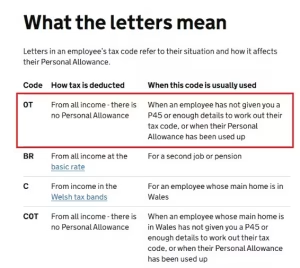
HMRC’s official tax-code table confirms that 0T means there is no Personal Allowance and explains the situations in which employers use the code.
Is Tax Code 0T Always Wrong?
No. A 0T tax code can be completely correct.
For the 2026/27 tax year, the standard Personal Allowance is £12,570.
However, the allowance starts reducing when adjusted net income exceeds £100,000.
It falls by £1 for every £2 of income above £100,000 and reaches zero when income reaches £125,140.
Someone whose Personal Allowance has legitimately fallen to zero could therefore have a 0T code without there being an error.
On the other hand, if you normally receive the standard Personal Allowance and 0T suddenly appears after changing jobs, it is worth checking whether HMRC has the correct information.
A wrong tax code can result in too much or too little Income Tax being deducted.
How Does Tax Code 0T Affect Your Pay?
The main effect of tax code 0T is that no Personal Allowance is deducted before PAYE Income Tax is calculated.
That does not mean everything is taxed at 40% or 45%. The appropriate Income Tax bands are still used.
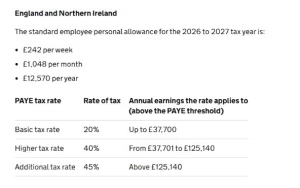
For England and Northern Ireland, the 2026/27 main PAYE bands are:
| Taxable Income Under 0T | Income Tax Rate |
| £1 To £37,700 | 20% |
| £37,701 To £125,140 | 40% |
| Over £125,140 | 45% |
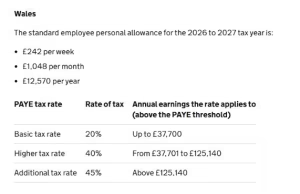
Wales currently uses the same main employment Income Tax rates, although Welsh PAYE codes use the C prefix where applicable. Scotland has separate Scottish Income Tax bands and rates.
England and Northern Ireland Tax Rate:
Wales PAYE Tax Rate:
Scotland PAYE Tax Rate:
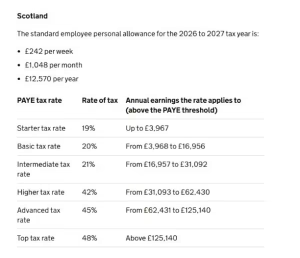
HMRC’s official 2026/27 payroll rates show the Personal Allowance and current Income Tax bands for England, Northern Ireland, Scotland and Wales.
Example 0T Tax Calculation
Suppose an employee in England earns £30,000 a year and has tax code 0T for the whole tax year.
Because 0T provides no Personal Allowance, the simplified annual calculation would be:
£30,000 × 20% = £6,000 Income Tax
Compare that with an employee earning £30,000 who qualifies for the standard £12,570 Personal Allowance:
£30,000 − £12,570 = £17,430 taxable income
£17,430 × 20% = £3,486 Income Tax
In this simplified example, 0T results in approximately £2,514 more Income Tax being deducted over the year.
This example assumes one employment, England’s main tax rates, no other tax adjustments and a full-year calculation.
Actual PAYE deductions can differ according to pay frequency, previous earnings and whether the code is cumulative or non-cumulative.
Tax Code 0T Vs 1257L, BR, D0 And D1
Understanding how 0T differs from other PAYE codes makes it easier to see why deductions can change significantly.
| Tax Code | General Meaning | How Income Is Taxed |
| 1257L | Standard Personal Allowance for many taxpayers | Personal Allowance is normally provided before tax bands apply |
| 0T | No Personal Allowance against that income | Normal applicable tax bands apply from the first pound |
| BR | Basic Rate | All income from that source is taxed at the basic rate |
| D0 | Higher Rate | All income from that source is taxed at the higher rate |
| D1 | Additional Rate | All income from that source is taxed at the additional rate |
HMRC confirms that 1257L is currently used for most people with one job or pension, while BR, D0 and D1 have different fixed-rate purposes.
This distinction is particularly important when comparing 0T and BR. A BR tax code normally taxes all income from that source at the basic rate.
With 0T, however, income can move through the basic, higher and additional-rate bands depending on how much taxable income is involved.
Is 0T An Emergency Tax Code?
0T by itself is not automatically an emergency tax code.
This is an important correction because 0T is often described as an emergency code simply because it frequently appears when somebody starts a new job.
HMRC says emergency treatment is identified when a tax code ends with:
- W1: Week 1 basis
- M1: Month 1 basis
- X: Emergency or non-cumulative treatment
- NONCUM: Non-cumulative treatment shown by some payroll systems
If your code does not end with W1, M1, X or NONCUM, HMRC says you are not on an emergency tax code.
This means:
0T = No Personal Allowance
0T M1 = No Personal Allowance and Month 1 emergency treatment
0T W1 = No Personal Allowance and Week 1 emergency treatment
The difference between the underlying code and the emergency marker matters.
The wider rules around an emergency tax code also explain why somebody starting a job without complete previous-pay information may initially see unusual deductions.
What Does 0T M1 Mean?
0T M1 combines two instructions.
0T means there is no Personal Allowance against that income source.
M1 means payroll calculates the tax using only the current month’s pay rather than looking cumulatively at pay and tax from earlier months in the tax year.
HMRC describes M1 as an emergency tax-code marker.
The effect can be particularly noticeable after changing jobs or where earnings vary significantly.
The treatment of Tax Code 0T M1 therefore differs from a normal cumulative 0T code.
What Does 0T W1 Mean?
0T W1 works on a similar principle but applies to weekly payroll.
Rather than looking at cumulative income and tax across the tax year, PAYE is calculated using the current week’s pay.
W1 does not restore a Personal Allowance to a 0T code. The employee still has no tax-free allowance against that income source, while the W1 marker changes how the PAYE calculation is applied during that pay period.
How To Fix A Wrong 0T Tax Code?
If 0T correctly reflects your tax circumstances, there may be nothing to fix.
However, if you believe it has been applied because HMRC or your employer is missing information, start by checking your tax records rather than immediately filing a Self Assessment return.
You can normally take the following steps:
- Check Your Payslip: Confirm whether the code is 0T, 0T M1, 0T W1 or another variation.
- Check Your HMRC Record: Review the jobs, pensions and estimated income HMRC has recorded for you.
- Provide Your P45: Give your new employer your P45 if you have recently changed jobs and have not already provided it.
- Check Previous Employment: Make sure HMRC knows if an old job has ended.
- Review Estimated Income: An incorrect income estimate can affect how your Personal Allowance is allocated.
- Update HMRC: Correct inaccurate employment, pension or income information through HMRC’s online service.
- Check Later Payslips: Make sure your employer has applied any replacement code issued by HMRC.
Your employer generally cannot simply replace 0T with a more favourable code because you request it.
Payroll normally needs to operate the code HMRC provides or follow the relevant PAYE starter procedures.
How Long Does HMRC Take To Change Tax Code 0T?
There is no fixed lifespan for 0T because the reason for receiving the code matters.
If you have just started a new job, HMRC says it can take up to 35 days from starting the job to receive the necessary information and update an emergency tax code.
If you update incorrect information and HMRC decides your tax code needs changing, it says it will normally update the code and tell both you and your employer within 15 working days.
A legitimate 0T code caused by having no available Personal Allowance may remain in place for longer.
When Will The Correct Tax Code Appear On Your Payslip?
Once HMRC has issued a replacement tax code, it may not appear immediately.
HMRC says that if you are:
- Paid Monthly: The new code should normally appear on your next or following payslip
- Paid Weekly: The new code should normally appear by your third payslip
If the replacement code still does not appear, check with your employer to confirm that the latest HMRC coding instruction has reached payroll.
Will You Get A Tax Refund After Being On 0T?
You may receive a refund if 0T caused more Income Tax to be deducted than you actually owed, but a refund is not automatically due simply because you had a 0T code.
The answer depends on:
- Your Total Income: Income from all jobs, pensions and other taxable sources matters
- Your Available Allowances: You may or may not have been entitled to a Personal Allowance
- Tax Already Paid: HMRC compares deductions with the amount actually due
- When The Code Is Corrected: An in-year correction may affect subsequent payroll deductions
- Whether The Tax Year Has Ended: HMRC may reconcile the position after 5 April
Where too much or too little tax has been paid by the end of the tax year, HMRC may issue a P800 tax calculation or, in some circumstances, a Simple Assessment.
A wrong tax code is specifically listed by HMRC as one reason a PAYE taxpayer may receive a tax calculation.
Can Tax Code 0T Be Used On A Pension?
Yes. PAYE tax codes are not limited to employment income.
HMRC says taxpayers can have a tax code for each employment or pension, and the meaning of 0T can apply to income from a job or pension where no Personal Allowance is allocated to that source.
For example, somebody receiving employment income and a workplace pension may have their Personal Allowance allocated against one source while tax is deducted differently from the other.
The presence of 0T on a pension therefore does not automatically mean the pension provider has made an error.
What Are S0T And C0T Tax Codes?
The prefix can change depending on where in the UK you are treated as resident for Income Tax purposes.
S0T is the Scottish version of the code. It means no Personal Allowance is being given against that source and Scottish Income Tax rates apply.
C0T is the Welsh version. It similarly indicates that there is no Personal Allowance against that income, while Welsh Income Tax treatment applies.
HMRC confirms that S identifies Scottish Income Tax treatment and C identifies Welsh Income Tax treatment.
Scotland has different employment Income Tax bands. For 2026/27 these range from a 19% starter rate to a 48% top rate, meaning the calculation under S0T can differ substantially from 0T calculations elsewhere in the UK.
Does Tax Code 0T Affect National Insurance?
Tax code 0T determines how PAYE Income Tax is deducted. It does not itself determine how National Insurance contributions are calculated.
National Insurance has its own contribution categories, earnings thresholds and rates.
This means an employee can have 0T for Income Tax while their National Insurance continues to be calculated separately through payroll.
Conclusion
Tax Code OT is normally a mistaken way of writing Tax Code 0T, where the first character is the number zero.
The important point is that 0T means no Personal Allowance is being applied to that particular job or pension.
It does not mean that all income is automatically taxed at 40%, and plain 0T is not automatically an emergency tax code.
Your income is instead taxed through the applicable PAYE bands from the first pound.
For some people, particularly those whose Personal Allowance has been used elsewhere or reduced to zero, 0T may be correct.
For others, it can appear temporarily because an employer or HMRC does not yet have enough information.
If the code appears unexpectedly, check your payslip, employment details and HMRC record before assuming it is wrong.
Correcting incomplete information promptly can help ensure that future PAYE deductions reflect your actual circumstances.
Frequently Asked Questions
What Is Tax Code OT?
There is normally no separate UK PAYE code called OT. People searching for Tax Code OT generally mean Tax Code 0T, with the number zero, which means no Personal Allowance is allocated to that income source.
Is 0T A Bad Tax Code?
Not necessarily. 0T can be correct if your Personal Allowance has been used elsewhere or reduced to zero, although it should be checked if it appears unexpectedly.
Why Have I Suddenly Been Put On 0T?
It may happen after starting a new job without complete previous-pay information, because your Personal Allowance has been allocated elsewhere, or because HMRC’s records need updating.
Does Tax Code 0T Mean I Pay 40% Tax?
No. 0T uses the applicable Income Tax bands. For England and Northern Ireland in 2026/27, income can be taxed at 20%, 40% or 45% depending on the amount.
How Long Does Tax Code 0T Last?
There is no fixed duration. A temporary code may change once HMRC receives the required information, while a legitimate 0T code can remain if you have no Personal Allowance available.
Will I Get A Refund If Tax Code 0T Was Wrong?
You may receive a refund if the code resulted in too much Income Tax being deducted. HMRC may correct this through payroll or reconcile the position after the tax year.
Is 0T The Same As An Emergency Tax Code?
No. Plain 0T is not automatically an emergency code. HMRC identifies emergency treatment through markers such as W1, M1, X or NONCUM.
What is your reaction?