
Which Bank Is Best for a Business Account? | Top 10 UK Business Accounts

Last reviewed: 7 September 2026
The best bank for a business account in the UK depends on how the business actually operates. For a digitally run sole trader or small limited company, Monzo, Starling and Mettle are among the strongest options.
A company handling cash, cheques or more complicated banking needs may be better served by HSBC, NatWest, Lloyds or Barclays, while Revolut is particularly relevant to businesses dealing internationally.
Independent business banking service-quality results published in August 2026 put Monzo first with 85%, Starling second with 83%, Mettle third with 82%, Handelsbanken fourth with 78%, and Tide joint fifth with 69% for overall service quality. The survey covered approximately 1,200 SME customers at each of 17 providers.
However, the account with the highest customer-service score will not necessarily be the best account for a restaurant depositing cash every day, a company with three directors, an Amazon seller receiving international payouts or a business needing a large overdraft.
This comparison therefore considers fees, eligibility, cash deposits, international payments, accounting connections, team permissions, interest opportunities, security, lending and real-world business structure, rather than simply ranking accounts by their headline monthly fee.
Businesses that have not yet completed their company setup may also want to check how to register a new business in the UK before applying for an account.
What Are the Top 10 Best Business Bank Accounts in the UK?
| Rank | Business account | Typical account fee | Particularly good for | Important limitation |
| 1 | Monzo Business | Lite £0; Pro £9; Team from £25/month | Digital SMEs and app-based banking | Limited eligible business structures |
| 2 | Starling Business | £0/month | Free everyday business banking | Cash deposits carry charges and limits |
| 3 | Mettle by NatWest | £0/month | Sole traders, freelancers and small Ltd companies | No cheque deposits or business borrowing |
| 4 | Handelsbanken Business Current Account | Typically £25/month | Relationship banking and established SMEs | Not designed as a quick, purely digital signup |
| 5 | Tide Business | Free plan; paid plans available | Startups, contractors and growing teams | Transaction and cash fees vary by plan |
| 6 | HSBC Small Business Banking Account | £0 monthly account fee currently | Established SMEs wanting traditional banking | Cash and some assisted transactions cost extra |
| 7 | Revolut Business | From £10/month | International and multi-currency businesses | Best features sit on higher paid plans |
| 8 | NatWest Business/Start-up Account | Depends on account and promotional eligibility | Startups wanting branches, lending and FreeAgent | Standard charges apply outside promotional terms |
| 9 | Lloyds Business Account | No account fee for first 12 months for eligible new customers; then £8.50/month | Branch banking and established SMEs | Transaction and cash charges can accumulate |
| 10 | Barclays Business Account | Depends on chosen pricing plan | Traditional banking and businesses with established mandates | Pricing and multi-user arrangements are less simple than app-only accounts |
Fees and promotional terms can change, so applicants should check the provider’s current tariff immediately before applying.
1. Monzo Business – Best Overall for Digital Small Businesses

Monzo takes the top position because it combines competitive pricing, strong mobile banking, accounting functionality and unusually strong customer-service results.
Its current business range includes Monzo Business Lite for £0, Pro for £9 a month and Team from £25 a month. More advanced plans add features such as accounting integrations, virtual cards, invoicing functions, expense management and team controls.
Monzo was also ranked first for overall business current-account service quality at 85% and first for online and mobile banking at 90% in the August 2026 independent survey.
There is an important eligibility restriction, however. Monzo Business is primarily aimed at UK sole traders and directors of UK limited companies. It does not support every legal structure, including various partnerships, LLPs, charities and other organisations. Applicants also need to meet its UK residence and tax-residence requirements.
Best suited to: freelancers, consultants, agencies, contractors and smaller limited companies that predominantly receive and make electronic payments.
2. Starling Business – Best Free Business Bank Account

Starling remains one of the strongest choices for businesses wanting a full UK business current account without a monthly subscription.
The standard business account has no monthly account fee, with free standard UK payments. Cash can be deposited through the Post Office, although Starling currently charges 0.7% of the deposit or £3, whichever is higher. ATM withdrawals are subject to applicable account limits.
Starling came second overall with an 83% recommendation score and second for online and mobile banking with 87% in the August 2026 business banking survey.
The biggest consideration is eligibility. Starling explicitly restricts certain activities and does not permit its standard business account to be used for holding client money.
Businesses in areas including gambling, adult entertainment, some financial services, precious metals and other higher-risk activities should check eligibility before making an application.
Best suited to: ordinary UK SMEs that want low-cost everyday banking without needing large cash-deposit facilities.
3. Mettle – Best for Freelancers and FreeAgent Users

Mettle is provided by NatWest and has developed into a particularly strong option for sole traders and small limited companies.
There is no monthly account charge, and eligible Mettle customers can receive access to FreeAgent accounting software without the normal subscription charge, provided the required account activity conditions are met.
That makes Mettle particularly interesting for sole traders affected by digital tax reporting. Those preparing for HMRC’s digital requirements can also read about the latest Making Tax Digital changes.
Mettle ranked third overall at 82% in the August 2026 independent business banking survey.
However, it is not suitable for every organisation. Applicants generally need to meet UK residence and tax-residence requirements, and Mettle does not support several structures and industries. It also does not offer cheque deposits or conventional business credit products through the account.
Best suited to: sole traders, freelancers and small service companies that want banking and bookkeeping closely connected.
4. Handelsbanken – Best for Relationship Banking
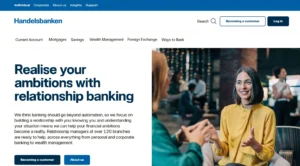
Handelsbanken is a very different proposition from Monzo, Starling or Mettle.
Instead of concentrating on instant app-based onboarding, it uses a relationship-banking model with a dedicated local relationship team.
Its Business Current Account supports UK and international payments, different currencies, branch access and potential overdraft facilities subject to approval.
The account typically costs £25 a month, although Handelsbanken states that the charge can sometimes be waived depending on other products held.
Its corporate customers commonly have an established trading history, making it more relevant to developed SMEs than someone testing a new side hustle.
That service model is reflected in the independent survey. Handelsbanken ranked fourth overall at 78% and first for relationship/account management at 86% in August 2026.
Best suited to: established businesses wanting an ongoing relationship with people able to discuss lending, cash flow and broader banking requirements.
5. Tide – Best for Startups Wanting Flexible Plans
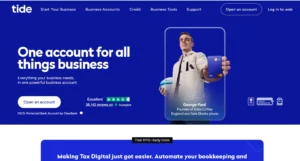
Tide offers several account levels, allowing a business to start with a free plan and move into additional tools as it grows.
Its current range includes Free at £0, Smart at £12.49, Pro at £27.49 and Max at £69.99 per month. Transaction allowances, team cards, support and additional features vary by plan.
This makes Tide particularly useful for contractors, sole traders and small companies that want expenses, invoicing and banking functions within a business-focused platform.
Cash can also be deposited through supported networks, although charges apply.
Businesses that regularly take hundreds or thousands of pounds in physical cash should therefore compare the effective annual cost against a high-street bank rather than looking only at Tide’s £0 entry price.
Tide was joint fifth for overall service quality at 69% and joint fourth for online/mobile banking at 74% in the August 2026 survey.
Best suited to: startups, contractors and small teams that want integrated business-administration features.
6. HSBC Small Business Banking Account – Best for Traditional Banking Without a Monthly Fee
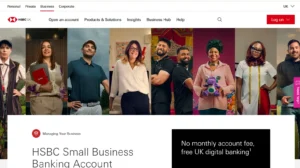
HSBC’s Small Business Banking Account is worth separating from its broader business banking products.
The current Small Business Banking Account has no monthly account maintenance fee and includes standard UK digital transactions without a separate charge, subject to the account tariff and eligibility conditions. Cash, assisted and other services may carry fees.
Unlike many app-only providers, HSBC can also suit businesses that expect their banking requirements to become more complicated, for example where lending, cash deposits or multiple people managing an account become important.
HSBC states that more than one person can manage relevant business banking arrangements, making it more practical than single-user accounts for some companies with multiple directors.
Best suited to: SMEs wanting a major high-street banking group without paying a headline monthly fee for the basic small-business account.
7. Revolut Business – Best for International Business

Revolut deserves particular attention in a 2026 comparison because its UK status changed significantly this year.
Revolut Bank UK launched on 11 March 2026 after restrictions on its UK banking licence were lifted. Eligible deposits held with Revolut Bank UK can now receive FSCS protection up to the applicable limit.
Businesses should still check their own account documentation because migration arrangements can affect which Revolut entity currently provides an account.
Revolut Business plans currently start at £10 per month, with higher tiers increasing currency-exchange allowances, transfer allowances and administrative features.
The platform supports more than 25 currencies and provides particularly detailed team-card and spending controls.On eligible plans, businesses can create approval workflows, assign team access and issue multiple physical or virtual cards.
Revolut currently states that businesses can have up to three physical corporate cards and up to 50 virtual cards per team member, subject to plan conditions.
Best suited to: international agencies, importers, exporters, remote teams and businesses frequently paying or receiving money in multiple currencies.
8. NatWest – Best High-Street Account for Startups
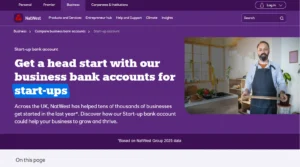
NatWest remains competitive for new businesses because eligible startup accounts can receive two years without transaction charges on everyday banking, subject to its current terms.
Another major benefit is FreeAgent. Eligible NatWest business current-account customers can obtain FreeAgent without its normal subscription cost, which can materially change the overall value comparison for businesses already planning to pay for accounting software.
Anyone comparing that benefit against Xero, QuickBooks or another platform can also look at iBusinessTalk’s comparison of small business accounting software.
NatWest becomes particularly relevant when a startup expects to need branches, borrowing or broader commercial banking later rather than simply needing a card and sort code.
Best suited to: new UK companies that want startup banking, accounting integration and access to a large established banking group.
9. Lloyds Business Account – Best for Businesses Wanting Branch and Digital Banking

Lloyds is a practical middle ground between app-based banking and more traditional commercial banking.
Eligible businesses opening their first Lloyds business account can currently receive 12 months without the account maintenance fee. The standard monthly fee is then £8.50 under its current tariff, while transaction and cash-deposit charges can also apply.
Its advantage is breadth rather than simply being the cheapest. A business can combine digital banking with established payment, branch, cash and lending infrastructure.
That can be more useful to a retailer, trade business or growing employer than saving a few pounds a month on an account that cannot handle the way the company operates.
Best suited to: established SMEs wanting conventional banking infrastructure alongside modern digital access.
10. Barclays Business Account – Best for Traditional Mandates and Established Companies

Barclays remains worth considering for established companies, particularly those already using a conventional banking structure.
Rather than presenting one simple flat-price product for every business, Barclays uses different business banking price plans based on transaction behaviour. That means the cheapest option depends on how a company receives and sends money.
Barclays also supports businesses where more than one person is involved in banking, although its digital arrangements can be less straightforward than the role-based permission systems offered by newer fintech providers.
For example, Barclays states that where multiple people manage an account, applicable users may need to complete its Mobile Banking Waiver before using certain app functionality.
Best suited to: established companies already comfortable with traditional bank mandates, branches and commercial banking processes.
Which Business Account Is Best for Your Actual Situation?
A simple ranking is not enough because two businesses with identical turnover can require completely different accounts.
| Business situation | Accounts worth shortlisting | Why |
| Sole trader or freelancer | Monzo, Starling, Mettle | Low fees and strong digital bookkeeping |
| Small limited company | Monzo, Starling, HSBC | Good everyday banking with different levels of traditional support |
| New startup | Mettle, Tide, NatWest | Low initial cost plus bookkeeping/startup features |
| Cash-heavy hospitality or trade business | HSBC, NatWest, Lloyds, Barclays | Better fit for regular cash/branch requirements |
| International or multi-currency company | Revolut, Handelsbanken | International payment and currency capability |
| Several employees needing cards | Revolut, Monzo Team, Tide | More granular card and expense controls |
| Two or more directors requiring approvals | Revolut, Monzo Team, HSBC, Barclays | Better multi-user or mandate functionality |
| Established SME wanting a relationship manager | Handelsbanken | Relationship-led local banking |
| Amazon/eBay/e-commerce seller | Revolut, Mettle, Monzo, Tide | Useful payment, accounting and digital transaction tools |
| Client-money or escrow-style business | Specialist client account | Ordinary SME current accounts may explicitly prohibit client money |
| Crypto, adult or other high-risk sector | Specialist regulated provider | Many mainstream providers explicitly exclude these activities |
| Non-UK resident directors | Specialist international providers; Revolut/Wise may warrant checking | Eligibility varies substantially by residence, ownership and country |
What Is Best for Amazon, eBay or Etsy Sellers?
Online sellers should look beyond the monthly banking fee.
The important questions are whether marketplace payouts can be received efficiently, how foreign-currency receipts are converted, whether transaction data feeds cleanly into accounting software and whether extra cards can be issued to staff.
Mettle can be attractive where FreeAgent fits the accounting workflow, while Revolut is stronger where significant international currencies are involved. Monzo and Tide are also worth considering for businesses prioritising app-based expense and accounting tools.
The direct integration between a particular marketplace and bank should always be checked before applying because Amazon, eBay, Etsy and payment processors can change their supported payout arrangements.
What About Crypto, Web3, Gambling or Adult Businesses?
This is where generic “best bank account” comparisons become particularly misleading.
Several mainstream providers explicitly restrict higher-risk industries. Mettle, Starling and Wise, for example, publish restrictions affecting categories that can include cryptocurrency, gambling, adult services or regulated financial activities.
A business in one of these sectors should not repeatedly apply to ordinary SME accounts hoping that one application gets through. It is generally better to approach a regulated provider specialising in the relevant industry and obtain confirmation that the exact activity, jurisdictions and payment flows are acceptable.
Can a Non-UK Resident Director Open a UK Business Account?
Possibly, but the number of realistic options becomes smaller.
Traditional UK banks commonly require substantial UK connections and may request a UK business or trading address, information about directors and beneficial owners, tax residence, expected turnover and evidence explaining why a UK account is required.
Government guidance also notes that overseas companies can face additional checks when establishing UK banking arrangements.
Specialist international platforms such as Wise and Revolut may be worth checking where directors live overseas, although Wise is not a bank, and neither provider guarantees acceptance simply because a company is UK registered. Country, ownership structure, business activity and source of funds all matter.
Why Do Business Bank Account Applications Get Rejected?
A rejected application does not necessarily mean the business has done anything wrong.
Business-account providers operate under anti-money-laundering, sanctions, fraud and customer-due-diligence requirements and are also free to define the types of businesses they are prepared to serve.
| Possible issue | Why it matters | What the business should check |
| Unsupported industry | The provider may prohibit the business activity | Check the provider’s restricted-sector policy before reapplying |
| Non-UK directors or owners | Creates additional verification and jurisdiction risk | Check residency requirements in advance |
| Offshore ownership structure | More beneficial-owner and source-of-funds checks may be required | Prepare a clear ownership chart and supporting records |
| No UK trading presence | Some providers require UK residence or trading activity | Choose a provider designed for international ownership |
| Companies House information does not match application | Creates identity/KYC inconsistencies | Correct company, PSC and director information first |
| Complex source of funds | The provider may need evidence showing where money comes from | Prepare contracts, accounts, invoices and funding documentation |
| Client money | Many standard accounts prohibit holding money on behalf of others | Use an appropriate specialist client account |
| Adverse credit or fraud information | May affect risk assessment, particularly where credit is requested | Check credit files and correct genuine errors |
| PEP connection | Requires enhanced, risk-based due diligence | Be prepared for additional verification rather than assuming automatic rejection |
A politically exposed person (PEP) should not automatically be denied an account simply because of PEP status. The FCA states that financial firms should apply a proportionate, risk-based approach, although legislation requires additional due-diligence measures.
What Should You Do If a Bank Has Already Rejected Your Business?
First, check whether the rejection resulted from a simple eligibility mismatch. An LLP applying to a sole-trader-focused account or a crypto business applying to a provider that expressly prohibits virtual-currency activity is unlikely to solve the problem by sending another application.
The business should then verify its Companies House information, PSCs, addresses, director details, trading activity and tax-residence information. Supporting evidence around expected turnover and source of funds should be consistent with the application.
If borrowing rather than the current account itself is the problem, improving business and personal credit information may also be relevant. iBusinessTalk has separate information on securing financing when a startup has little credit history.
Where the business believes it has been treated unfairly, it can use the provider’s formal complaints process. Eligible small businesses can also take certain unresolved banking complaints to the Financial Ombudsman Service.
Which Business Bank Accounts Pay Interest?
One easily missed point is that a business current account and an interest-paying business savings account are usually separate products.
Keeping £50,000 or £100,000 permanently in a zero-interest operating account can therefore have an opportunity cost. Businesses with consistently large cash reserves should compare linked savings products as well as current-account charges.
Examples available in 2026 include:
| Provider | Example savings option/rate | Important point |
| Monzo | Business Instant Access Savings Pot around 1.30% AER variable | Separate savings pot rather than interest on normal operating balance |
| Tide | Instant Saver rates vary by membership plan, roughly 2% to 3.25% AER before applicable promotional rates | Higher subscription tiers can receive higher rates |
| NatWest | Business Reserve and notice accounts available; rates vary by balance/notice period | Notice accounts may pay more but reduce immediate access |
| Santander | Business savings products include instant-access/reward and fixed options | Separate account required |
Rates are variable or regularly replaced, so businesses should check the live rate rather than relying on an old comparison article.
The important comparison is therefore not simply “which current account pays interest?” but “how easily can excess operating cash be moved into an interest-bearing account without interfering with payroll, VAT and supplier payments?”
Businesses experiencing cash-flow pressure from tax obligations may also find iBusinessTalk’s discussion of VAT and business cash-flow pressure relevant.
What Do Financial Ombudsman Complaints Tell Us?
Complaint data gives a more useful reality check than relying entirely on Trustpilot reviews.
During the 2025/26 financial year, the Financial Ombudsman Service received 4,091 complaints specifically about business current accounts, and 27% of resolved cases were upheld.
Between January and March 2026 alone there were 1,007 new business-current-account complaints, with a 24% uphold rate.However, raw complaints against individual banks should not be used as a simplistic “worst bank” ranking.
A provider with millions of customers can naturally generate more complaints than a small specialist bank, and public FCA firm-level complaint figures cover different product mixes rather than creating a clean like-for-like business-current-account comparison.
For provider comparisons, the regulated independent service-quality survey is therefore particularly useful. Its August 2026 overall top five were Monzo 85%, Starling 83%, Mettle 82%, Handelsbanken 78% and Tide 69%.
That data still should not override practical requirements such as cash deposits, lending or joint approval mandates.
Which Accounts Have the Best Security and Fraud Controls?
Security is more complicated than asking whether a bank offers two-factor authentication.
Businesses should examine login security, payment verification, ability to freeze cards instantly, virtual cards, individual card limits, team permissions, approval workflows and fraud support.
Monzo publishes features including biometric authentication, instant card freezing, 3D Secure and additional anti-fraud measures such as its in-app call-status feature.
Revolut provides particularly granular corporate-card controls. Depending on the plan, businesses can restrict spending, currencies and merchant categories, issue virtual cards and create approval processes for company spending.
Tide provides business team-access functionality and additional employee cards on qualifying plans, while traditional providers such as HSBC and Barclays accommodate multiple authorised users or mandates.
Businesses should also check Confirmation of Payee availability for the payment types they commonly use rather than assuming every incoming and outgoing payment follows identical verification rules.
What Happens If a Business Falls Victim to an APP Scam?
The UK’s mandatory Authorised Push Payment scam reimbursement regime has applied since 7 October 2024.
For qualifying Faster Payments claims, the standard maximum reimbursement level is currently £85,000 per claim. Providers can apply an excess of up to £100 in permitted circumstances, although individual firms can choose to provide more generous protection.
The PSR reported in its 2026 monitoring that reimbursement under the regime remains high for claims classified as reimbursable.
The scheme does not mean a business should ignore its own payment controls. Companies sending high-value supplier, payroll or acquisition payments should strongly consider dual approvals, independent supplier-detail verification and restrictions on which employees can create or approve beneficiaries.
Which Business Account Is Best for Multiple Directors and Employees?
This is one area where a simple “free account” comparison can produce the wrong answer.
| Provider | Multi-user strength | Practical point |
| Revolut Business | Strong | Custom permissions, cards and approval workflows on relevant paid plans |
| Monzo Team | Strong | Expense cards, team controls and payment approval functionality |
| Tide | Good | Team access and employee cards; allowances depend on plan |
| HSBC | Good | More than one person can manage eligible business banking arrangements |
| Barclays | Traditional mandate approach | Supports multiple authorised users but digital setup can involve additional mandate/waiver steps |
| Handelsbanken | Relationship-led | Better suited where access and banking requirements need to be discussed with a relationship team |
For a one-director consultancy, paying extra for sophisticated approval workflows may be unnecessary. For a company where one employee creates a £20,000 supplier payment and another director must approve it, those controls can be far more important than a £5 or £10 monthly saving.
How Do Business Cards Differ Between Providers?
A debit card is no longer just a plastic card attached to the account.
Businesses should compare the number of cards included, employee card fees, virtual-card availability, ATM fees and limits, foreign-currency costs and whether administrators can impose individual spending restrictions.
Revolut is one of the clearest examples: its current business plans can support up to three physical cards and up to 50 virtual cards per team member, alongside plan-dependent approval and expenditure controls.
Monzo’s paid business plans add virtual cards and stronger team expense controls, while Tide’s Smart, Pro and Max tiers include different employee-card allowances.
For a business with ten employees, these differences can make the real annual account cost very different from the advertised headline monthly fee.
Which Bank Is Best for a Cash-Heavy Business?
Restaurants, pubs, tradespeople, convenience stores, salons and other businesses receiving substantial physical cash should generally give cash handling more weight than app design.
Starling supports Post Office cash deposits but currently charges 0.7% or at least £3 per deposit, and cash limits apply. Tide also supports cash deposits through specified networks but charges according to the channel and membership plan.
Traditional providers such as HSBC, NatWest, Lloyds and Barclays may therefore make more sense where regular branch, Post Office, cheque or cash-deposit facilities are required.
The correct comparison should calculate the likely monthly cost from the business’s actual deposit pattern rather than choosing the account with the lowest subscription price.
This becomes particularly important for companies temporarily holding large payroll, VAT, tax or acquisition balances.
Frequently Asked Questions
Which bank is best for a small business account in the UK?
Monzo, Starling and Mettle are strong choices for many small digital businesses. Cash-heavy or more complex companies may be better suited to HSBC, NatWest, Lloyds, Barclays or Handelsbanken.
Which business bank account is easiest to open?
App-based providers such as Monzo, Starling, Mettle and Tide can offer relatively streamlined applications for straightforward eligible businesses. Approval is never guaranteed and complex ownership, residency or regulated industries can require additional checks.
Which is the best free business bank account?
Starling is one of the strongest accounts with no monthly fee, while Monzo Lite, Mettle and Tide also offer £0 entry-level options. Transaction and cash charges still need to be compared.
Can a non-UK resident director open a UK business account?
Yes in some circumstances, but eligibility is more restrictive. Banks may require UK residency, a UK business presence or additional ownership documentation. Specialist international providers may be more flexible depending on the country and business activity.
Can two directors have access to the same business bank account?
Yes with many providers, but the level of control varies. HSBC and traditional banks support multiple authorised users, while Revolut and Monzo Team provide more granular digital permissions and approval workflows.
Which business bank account is best for earning interest?
Most current accounts do not pay significant interest directly on the everyday operating balance. The better comparison is often the linked business savings account offered by Monzo, Tide, NatWest, Santander or another provider.
Is Revolut a bank in the UK in 2026?
Yes. Revolut Bank UK launched on 11 March 2026 after its mobilisation restrictions were lifted. Businesses should nevertheless check which Revolut entity currently provides their particular account during the migration process.
Is Wise a bank?
No. Wise is a regulated payment/e-money provider rather than a traditional UK bank. Businesses should understand the difference between safeguarding arrangements and FSCS deposit protection before holding substantial cash balances there.
Why has my business bank account application been rejected?
Common reasons include unsupported business activities, eligibility rules, incomplete ownership information, residency issues, KYC problems, unusual source-of-funds arrangements or a mismatch between the application and Companies House records.
What is your reaction?